
There’s a lot to think about when deciding how and where your fleet’s going to charge. Upfront cost, ongoing charging costs, operational efficiency, physical space, electrical capacity and driver convenience are all key considerations.
So, how do you determine whether to rely on public charging facilities, implement on-site charging infrastructure, install chargers at drivers’ homes, or take a blended approach?
Drax Electric Vehicles explain the options.
Depot charging
Installing infrastructure at your depots enables you to plan charging around your fleet operations.
Owning on-site charging facilities lends itself to keeping a closer control on your vehicles’ whereabouts, their destinations, their mileages, when they need to charge – and your charging costs. Owned facilities also represent dedicated resources that bring charging reliability to your fleet operations, helping to minimise downtime.
Selecting and installing your own chargers means you can ensure the specifications match your needs – in terms of power and authorisation method, for example. It’ll also give you the ability to analyse charging-session data to help you optimise your operations, understand cost savings and calculate sustainability benefits.
In the future, your charging infrastructure may have the potential to generate revenue for you. Initially, however, implementing on-site charging facilities comes with complexity and a significant cost impact. It’s worth engaging an expert electrification partner (see below) to support, if you’re taking this route.
They’ll be able to simplify the challenge, join the dots and help you avoid expensive mistakes by:
- Arranging electrical site surveys – for understanding your electrical capacity, planning potential upgrades and designing layouts to maximise accessibility, optimise cable routing efficiency and minimise installation disruption
- Minimising hardware and installation costs – by recommending government support or funding options to spread outlay over time
- Recommending Grid connection options and coordinating accordingly – to help reduce costs, shorten timescales and manage any power-capacity upgrade requirements
- Planning implementation to minimise disruption – including proposals for a phased approach that reduces upfront costs and enables you to ‘learn as you go’
- Future-proofing your investment – to make sure even a phased approach has one eye on implications for tomorrow
Home charging
Many organisations’ fleet drivers take their vehicles home at the end of each shift. In these instances, installing dedicated home chargers for each vehicle provides driver convenience and operational efficiency.
Home chargers enable low-speed and cost-effective charging, often benefitting from cheaper overnight rates. They can also connect to your organisation’s ‘back office’ fleet management software, meaning you retain visibility of usage and charging costs.
There are, however, constraints and complexities with home-charging solutions.
Firstly, every situation’s unique. Not all drivers’ homes will have off-street parking. This may complicate and potentially prohibit charger installation. Each home layout’s different, too, so finding the best install locations and cabling routes takes time and coordination.
Secondly, persuading reluctant drivers that charger installation’s advantageous to them – as well as agreeing preferred cabling routes and charger locations at drivers’ homes – can prove challenging.
And thirdly, reimbursing drivers for energy spend isn’t simple – though there are solutions to manage this.
Again, electrification partners can prove invaluable in:
- Supporting with driver communications to help with engagement
- Planning home-charger rollout
- Designing solutions to minimise disruption
- Carrying out installations smoothly and efficiently
- Advising on charging-specific electricity tariffs
- Advising on reimbursement and setting up the solutions
Public charging
There are over 85,000 publicly accessible EV chargers in the UK, and the figure’s increasing all the time. Of these, over 15,000 are ‘rapid’, meaning they’re suitable for substantially boosting a vehicle’s remaining range in under an hour.
Apps such as Zapmap can help fleet managers and/or drivers plan their routes around available charging facilities.
And, of course, using public EV chargers means there isn’t an immediate requirement for costly, complex and potentially disruptive infrastructure implementation works at your sites or drivers’ homes.
However, these cost savings start dwindling the minute your drivers start charging at public facilities. Using rapid chargers is particularly expensive, and cost forecasting’s difficult as prices vary so much between locations and providers.
Different charging providers work with different apps. Different chargers support different payment or authorisation methods. Until ‘plug & charge’ becomes the payment standard, fleet drivers are likely to experience accessibility and interoperability problems.
Depending on public chargers also comes with a major reliability issue. You can’t be sure that public-charging locations will align with your fleet vehicles’ routes – or that they’ll be working or available when your drivers visit them. This is especially true at peak times – and queuing or awaiting fault-resolution means delays and disruption to fleet operations.
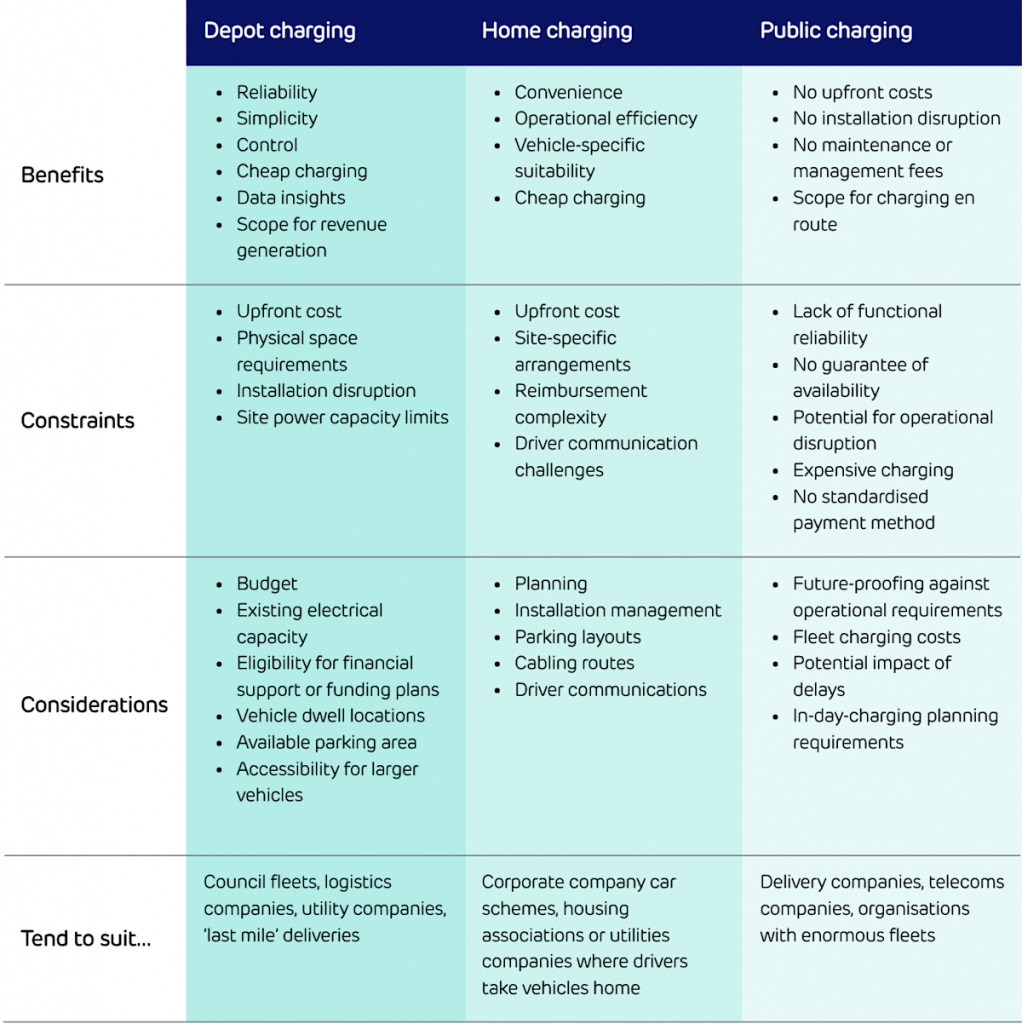
Comparing the options
Choosing the right mix
It may be obvious – given your organisation’s available space, sustainability commitments, fleet operations or budget, for example – which charging option will suit. However, it may be that a combination of the above charging options will service your needs best.
Carrying out assessments and surveys will generate the data you need to make informed charging decisions.
Upfront electrification/suitability assessment
Using telematics devices to track the movements of your existing internal combustion engine (ICE) fleet vehicles will show:
- Which vehicles are suitable for electrification now – and therefore how many and which types of vehicles you’ll need to provide charging solutions for
- Where vehicles travel – so the area in which they’ll need to charge
- Where vehicles dwell – and therefore the locations at which charging will cause least operational disruption
- When vehicles dwell – so when best to schedule charging
- Vehicle daily mileages – and therefore, when analysed alongside EV range and payload, whether vehicles will need to charge during the working day
The combination of these factors will help you recognise what specification of charger your vehicles need in order to fulfil their requirements. This will make it clear whether installing chargers at your drivers’ homes will be of benefit or not.
Site electrical survey
If you’re considering depot charging, it’s crucial to know more about the electrical capacity available. It may be that this limits the number – or the power – of chargers you’re able to install on-site.
This will leave you options – avoid depot charging, install what your remaining electrical capacity allows, or request capacity expansion via your Distribution Network Operator (DNO). Capacity expansion comes with a lead-time and a significant cost, but it might still be an option worth pursuing.
An electrical survey will also reveal optimal cabling routes for charger connection. These will affect the need for preparatory works, and dictate both the cost and the potential levels of disruption of depot-charging installation.
Projections
It’s difficult to assess the likelihood of operational or fleet-size changes in the future. However, it’s worth considering imminent or potential developments in ensuring your decision’s right for tomorrow as well as today.
Think of your charging strategy as a working document rather than a one-time decision. Particularly if you’re using a blended approach to charging, revisit practicalities and costs frequently to ensure you’re employing a charging mix that optimises efficiencies for your fleet.
Onboarding an expert
Engaging an electrification partner can prove invaluable in helping you plan effective charging solutions…
- Assessment
As shown in the previous section, data’s key to planning the right charging solutions for your organisation. An electrification partner can help you identify and source the data you need to make informed, cost-effective and future-proof charging decisions.
- Planning
By analysing the data they’ve helped you collate, an expert partner will be able to propose the charging locations – or mix of locations – that suit your fleet. If you’re planning to install infrastructure, they’ll also recommend charger specifications, payment/authorisation methods, cost-saving approaches and ways to engage with your drivers.
But, working with an expert that provides end-to-end electrification support means you can also expect valuable support when it comes to implementation and optimisation, too. This can include:
- Grid connection support and DNO communications
- Installation planning and on-site coordination
- Expert advice to help avoid expensive mistakes and future-proof your decisions
- Seamless delivery – connecting electrification phases for a smooth transition