Ashish Kolte, Marketing Manager at Dataintelo with expertise in marketing, market intelligence, and business strategy looks at the EV market in the USA and how it impacts energy infrastructure
The rise in usage of Electric Vehicles is presently showing that it is not just the matter for demand but also it has become the issue concerning engineering regarding the grids. With the expansion of the EVs fleet across the world, charging networks have transformed from a rather simple system into a complex layer of technology that will need to change how electricity is generated, and the load is managed. The previous conversation around EVs has revolved around their battery performance or availability now needs to take into consideration a very complex engineering matter about whether the electricity networks can keep up with the growing number of EVs.
A lot depends less on the number of EVs sold every year, and more on the way charging layer behind them is carefully designed. Whenever a network of charging stations is created simply as a collection of independent sockets, it cannot be deployed to such an extent without causing violations in the local grids and dealing with voltage fluctuation issues and overloads of transformers. This is the reason why utilities, distributors of charging stations, and technology providers are treating charging infrastructure as something more serious than just a supplement to the process of switching to EVs — the process that requires careful planning, monitoring, and adjustments in the same way as all substations or lines of transmission.
The numbers behind the shift
Federal statistics show that the development of infrastructure is not just a rumor; it is a reality. Data from the Alternative Fuels Data Center, which operates within the Department of Energy, shows the progression of public as well as private electric vehicle charging stations installations in the USA, which were 13696 in 2015, had increased to around 31751 in 2020, with a projection of exceeding the mark of 85000 stations set for the year 2025.
This growth curve matters because charging stations are not isolated hardware — each new site adds a node to a distributed energy network that utilities must forecast, manage, and often reinforce. A single fast-charging hub can draw as much peak power as a small commercial building, and clustering multiple hubs on one feeder can push local transformers past their rated capacity.
Why charging is now a grid technology problem, not just an EV problem
Three converging pressures are forcing charging infrastructure into the “critical technology layer” category:
- Peak load concentration – Electric vehicle (EV) fast charging is characterised by the ability of fast chargers to request extraordinary instantaneous power that concentrates the demand at specific locations.
- Unequal geographic distribution – In accordance with the data provided by the Department of Energy (DOE) on EV charging stations, the amount of chargers available is being distributed unevenly, causing some feeders and substations to have greater electrical load compared to others.
- Bidirectional power flow – The advent of V2G technology implies that EVs have all the chances to become not only consumers but producers. This means introducing new metering, monitoring and settlement systems.
- Variability of renewable supply – With the growth of renewable energy volume (solar and wind), charging demand should also be time-shifted from the fixed schedule into the time of maximum energy generation.
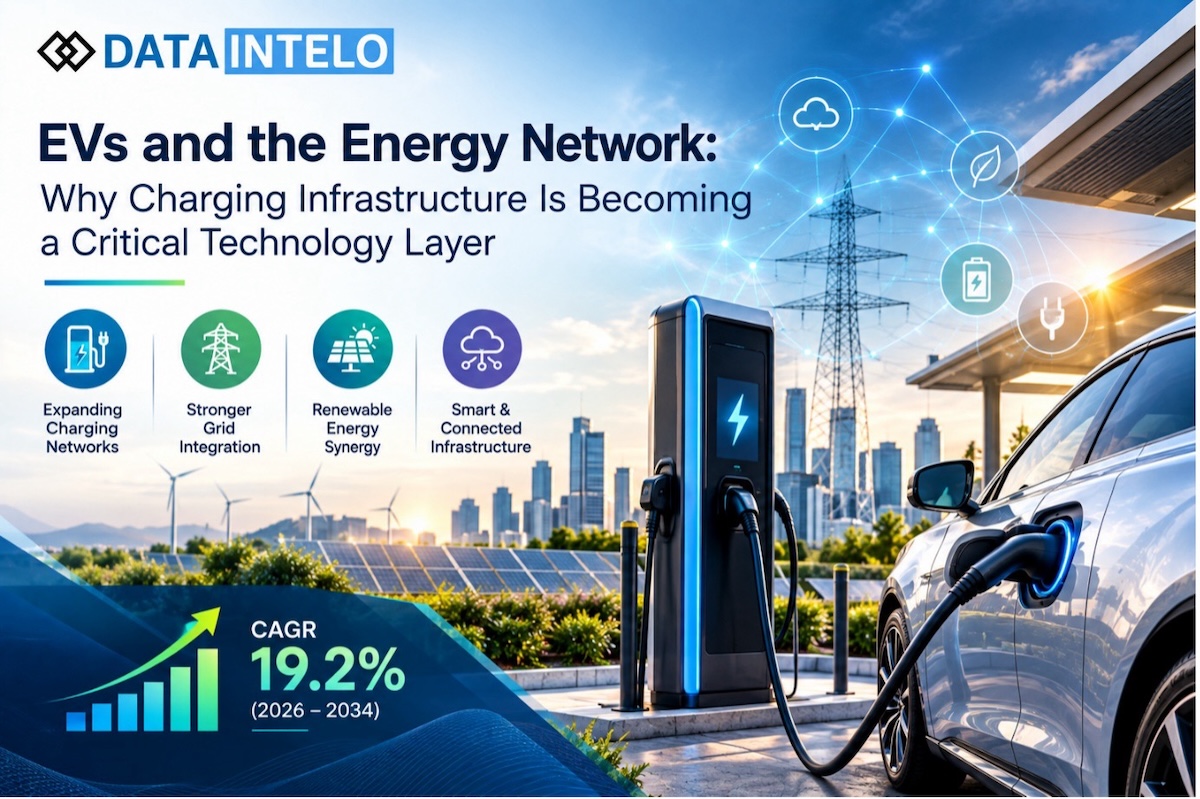
The significance of the investment in this transition comes from its magnitude: as stated by Dataintelo’s market research, the worldwide Electric Vehicle Charging Points Market was evaluated at $31.2 billion in 2025 and is expected to go up to $151.1 billion in 2034, growing at an annual rate of 19.2% from year 2026 to 2034. The growth of such a market means annually expecting the necessity for financing continuous technological investments rather than just hardware installation.
Charging Growth in Context
| Year | US EV Charging Stations (DOE, AFDC) | Approx. Growth vs. 2015 |
| 2015 | 13,696 | Baseline |
| 2020 | 31,751 | +132% |
| 2024 | 79,763 | +482% |
| 2025 | 85,692 | +526% |
That climb — from under 14,000 stations to nearly 86,000 in a decade — illustrates why grid planners can no longer treat charging load as a minor, predictable addition to the system. Each doubling of the network changes the shape of local demand.
The technology layer enabling grid-compatible charging
Hardware deployment gets attention, but the technology making this scale manageable increasingly lives in software and controls:
- Networked charge management allows operators to remotely monitor station status, manage sessions, and coordinate output across multiple connected chargers rather than treating each unit as standalone equipment.
- Dynamic load management automatically throttles charging speed across ports sharing a single electrical connection, preventing overload without requiring costly panel or transformer upgrades.
- Demand forecasting tools are increasingly used by network operators to anticipate charging demand by location and time window, informing both real-time load balancing and long-term capacity planning.
- Managed or ‘smart’ charging shifts sessions toward off-peak hours or periods of higher renewable output, reducing the strain that unmanaged, simultaneous charging would otherwise place on local grids.
- Vehicle-to-grid systems allow parked EVs to discharge stored energy back to the grid during peak demand periods, effectively turning a growing charging network into a distributed storage resource.
None of these capabilities are optional extras — as the DOE’s own station-count growth shows, the physical network is expanding fast enough that software-based coordination is becoming the only practical way to manage it without constant physical grid rebuilding.
Long-term trajectory
Instead of treating electric vehicles like a short-lived construction project, government energy agencies see this as a long-term planning matter. The long-term forecast of the U.S. Energy Information Administration indicates that a range between 13% and 29% of all light-duty vehicle sales will be taken up by electric cars by the year 2050 depending on such factors as cost and policy directions, which in turn means that grid planners will need to plan for multiple demand scenarios simultaneously rather than one forecast only.
That 16-percentage-point uncertainty band is itself informative: it means charging infrastructure investment has to be designed for flexibility, not a fixed endpoint. Networks built only for today’s charging patterns risk becoming bottlenecks within a decade, while over-built capacity carries its own capital inefficiency. This means that the Department of Energy data indicates that there are approximately 86,000 stations in existence today compared to less than 200 during the early 1990s, which demonstrates that this network has already crossed the experimental phase and has now moved into a phase of continuous growth.
What this means for energy and infrastructure stakeholders
- Substation and feeder upgrades are becoming a recurring line item rather than a one-off cost, particularly in corridors where DOE data shows station density concentrating fastest.
- Interoperability and control standards are becoming as commercially important as the physical charger itself, since networks now span thousands of individually owned and operated sites.
- Demand response participation by EV fleets is emerging as a genuine grid flexibility resource rather than a theoretical one, particularly for commercial and depot charging.
- Coordination between charge point operators and grid operators is shifting from optional to operationally necessary as station counts continue compounding at the rates DOE data confirms.
Charging infrastructure as energy infrastructure
The trajectory is clear from the data examined here: US charging station counts growing more than sixfold since 2015, a global market compounding at close to 20% annually according to research, and federal energy forecasts building in decades of continued EV growth through 2050. What ties these numbers together is that charging infrastructure has stopped behaving like a simple accessory to vehicle electrification. It now functions as an active layer of the energy network — one that has to forecast demand, manage bidirectional power flow, and integrate with renewable generation in real time. Stakeholders who treat charging deployment as a software and grid-integration challenge, rather than a hardware rollout, will be the ones positioned to scale without triggering the very grid bottlenecks this growth threatens to create.
Reference: https://dataintelo.com/report/global-electric-vehicle-charging-points-market
https://afdc.energy.gov/data/widgets/10332
https://afdc.energy.gov/data/10964
https://www.eia.gov/todayinenergy/detail.php?id=56480