
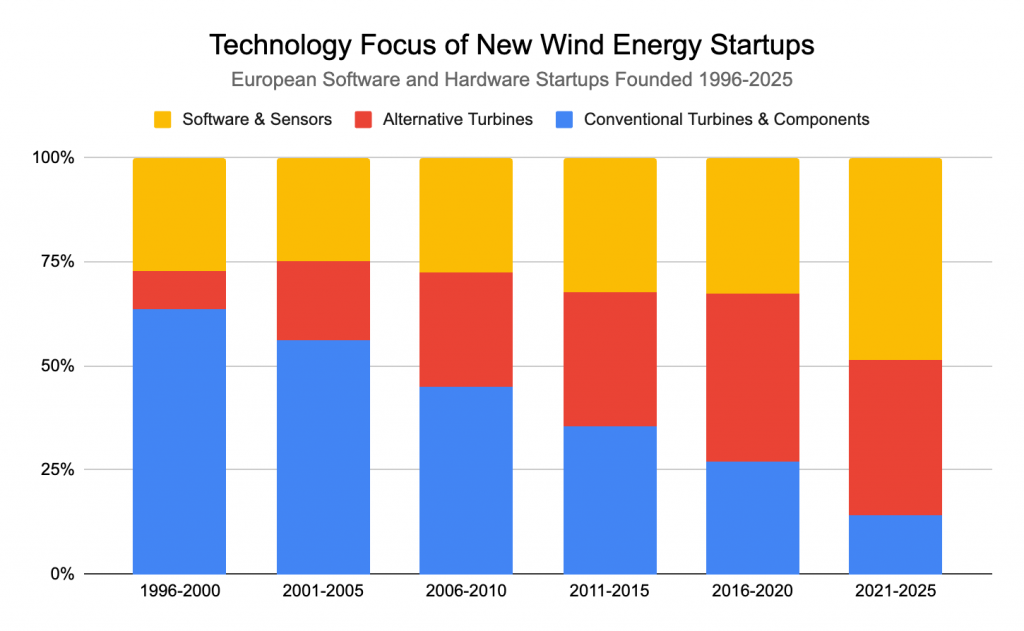
The proportion of European wind energy startups focusing on conventional (horizontal-axis) turbines and components has fallen considerably over the past 30 years, from 64% of the startups founded in the industry between 1996 and 2000 down to 14% of those started between 2021 and 2025.
Over the same time period, the proportion of new European wind startups focusing on alternative turbine designs has risen from 9% to 37%, and the proportion providing software and sensors has increased from 27% to 49%, reveals new research by Avnet Silica.
As wind turbine technologies continue to evolve, Avnet Silica analysed Crunchbase data to take a deeper look at the different products European startups are bringing to market, how much funding they’ve raised, and which products are attracting the most investment.
The study, which focuses on technological innovation, includes European startups developing wind energy hardware and software. It does not include project developers, installers, consultants, and other service providers.
Software and sensors set up to monitor, predict and optimise
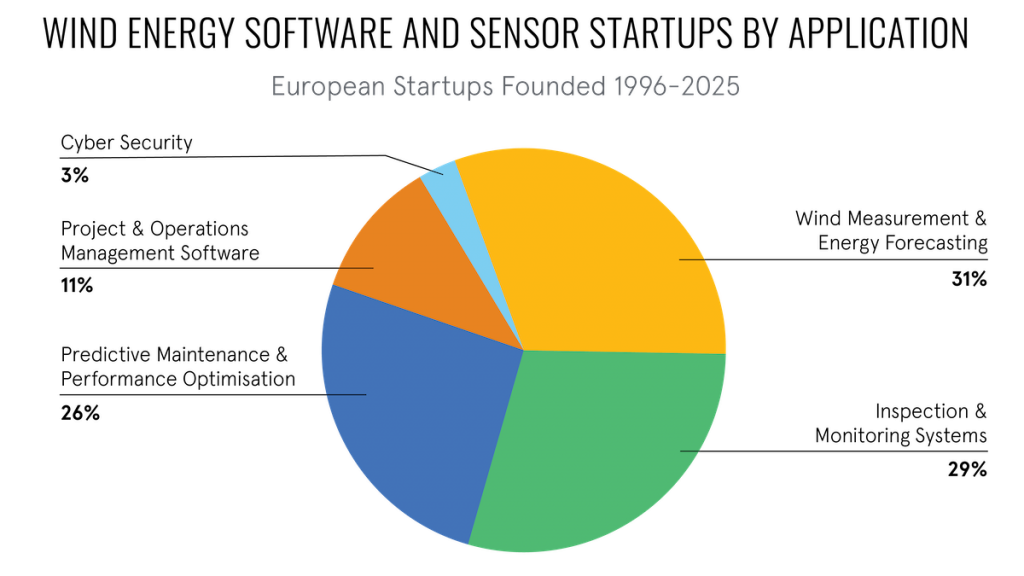
Among software and sensor startups, 31% focus on wind measurement and energy forecasting, 29% on turbine monitoring and inspection, and 26% on performance optimisation and predictive maintenance. A further 11% provide tools for project and operations management, while 3% specialise in cyber security.
The rise in airborne turbines and alternative designs
While 72% of companies founded between 2006 and 2015 offering alternative wind turbines opted for a vertical-axis design, this dropped to 37% between 2016 and 2025 with the rise of airborne (kite) technologies accounting for 33% of new entrants to the market. At the same time, a variety of new shapes appeared including conical, spherical, ducted, bladeless, and multi-rotor turbines.

Values indexed to the peak five-year period (=100)
European wind energy startups offering software and sensing technology have now raised a cumulative total of €83.5 million. The two companies drawing in the most have been Norway’s Spoor raising €11.8m for their AI-powered bird and bat monitoring, and Britain’s Cyber Energia (now Centrii) receiving €11.4m for their cyber security system.
For providers of alternative turbines, the largest grants and funding rounds have both gone to offshore wind propositions, with Sweden’s Sea Twirl receiving a €15m grant in 2025 for their floating vertical-axis turbine, and Norway’s multi-rotor Wind Catching System pulling in €9.6m in equity funding.
Reflecting on the research, Harvey Wilson, Senior Manager Industrial Vertical Markets EMEA at Avnet Silica, comments, “Startup activity offers a unique lens through which to view innovation in any technology space, even one dominated by well-established players like wind energy. Where new companies choose to compete shows us where opportunities exist, problems remain to be solved, costs can be saved and more value created.
“The lack of new entrants in conventional turbines shouldn’t however be interpreted as a lack of innovation. It’s just happening in a different place. Across the value chain, suppliers of electronic components and large turbine OEMs continue to iterate and transform the products they’re bringing to market.
“The same challenges that software and sensor startups are attacking from the outside, large scale manufacturers are aiming to engineer from within, continually increasing the levels of integration between hardware, software and sensors to gain greater levels of visibility and control.
“While producers of alternative turbines are exploring the boundaries of how and where wind energy can be generated, OEMs and software startups are tackling constraints within the current system, to maximise the value and energy they can gather from the wind.
“It’s always interesting to see how different companies push the boundaries of current technologies, to challenge themselves and others to do things differently, more efficiently, and to drive more business value.”