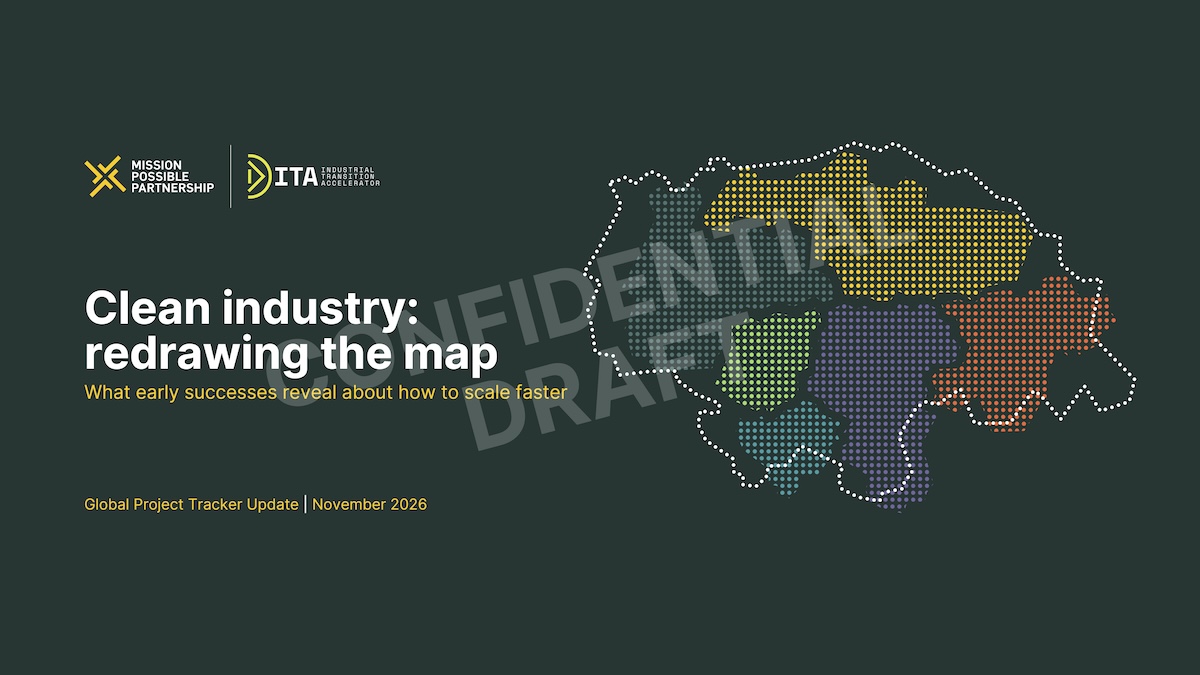
China and a growing group of renewables-rich emerging economies are attracting an increasing share of investment in clean industry, according to the latest findings from Mission Possible Partnership’s Global Project Tracker, supported by the Industrial Transition Accelerator (ITA). Clean industry, powered by renewable energy, is redrawing the world’s industrial map as projects move from the drawing board to construction.
Over the past 12 months, a record 36 clean industrial projects have reached final investment decision (FID). Sustainable aviation fuel (SAF), methanol (used as a vehicle fuel in Asia) and ammonia (a crucial component for fertiliser and the leading carrier for hydrogen) were the sectors leading the growth.
China accounted for 23 of those 36 clean industrial plants, securing $45 billion of financing, with emerging markets and developing economies across the new industrial sunbelt raising $5.3 billion investment across six large-scale facilities. Two of the new facilities in Kenya and
Paraguay will both be producing fertiliser for a mixture of domestic and export markets. Developed economies secured $4.8 billion investment for six projects in the same 12-month period.
The findings point to a widening geopolitical shift in clean industry as access to abundant renewable energy, supportive industrial policy and growing domestic markets shape where new production capacity is built.
Industrial policy drives China to become the world’s largest clean industrial powerhouse
China now accounts for almost half of all clean industrial plants operating or under construction worldwide. This year, the country deepened the transformation of its energy-intensive industries, financing 23 plants, nearly two thirds of the new global FIDs, covering the fuels, chemicals and metals sectors.
The country’s clean industrial growth has been supported by its industrial policy and its established renewable energy. Since the introduction of China’s 14th Five-Year Plan in 2021, which established dedicated plans for Industrial Green Development and Green Transport Development, there has been an increase in new clean methanol plants across the country as the domestic alternative fuel market took off.
China now accounts for over 90% of global clean methanol production capacity and over 40% of clean aluminium capacity worldwide. China’s Emissions Trading Scheme has expanded to include steel, cement and aluminium has boosted its clean aluminium sector, with 17 smelters now operating with renewable power and a further two under construction.
Renewables-rich countries drive the next wave of clean industry
Industrial capacity is spreading beyond its traditional heartlands. Eighty-nine countries are now developing commercial-scale clean industrial projects, including 70 with deep decarbonisation (70% or more emissions reduction).
Access to cheap renewable power is a decisive factor in where investment lands. Abundant renewable power in renewables-rich countries gives them a competitive advantage to attract energy-intensive industrial production, with clean industry offering a route to industrial growth, greater domestic value creation, local jobs and increased economic resilience.
Emerging markets across the new industrial sunbelt have secured $32 billion across 20 projects to date, with a further $2.6 trillion of investment potential in the 281 strong pipeline. Even in developed economies, the projects that advance to secure finance often sit in the most renewables-rich regions: Spain and Australia, with solar power, and Norway, with hydropower, all saw FIDs this year.
KenGen Kaishan Green Ammonia plant
Kenya is building Africa’s first geothermal-powered green fertiliser plant. Located at the Olkaria geothermal field in the Rift Valley, it will have access to low-cost round-the-clock stable power needed for chemical production. The KenGen Kaishan plant aims to produce 200,000-300,000 tonnes of fertiliser annually mainly for Kenyan farmers. Agriculture is central to Kenya’s economy and the country is one of sub-Saharan Africa’s largest fertiliser importers, relying on imports to grow maize, the country’s staple crop.
Faustine Delasalle, CEO, Mission Possible Partnership and Executive Director, Industrial Transition Accelerator, said, “This year, the new industrial sunbelt outpaced Europe for the first time, turning clean industrial plans into financed plants. From geothermal-powered fertiliser in Kenya to sustainable aviation fuels in Brazil, renewables-rich countries are converting their natural endowments into factories, jobs and revenue. In a year of supply chain disruption, clean industry is fast becoming a strategy for resilience as well as a driver of local economic development.
“The challenge now is scale and pace. We have seen a record number of final investment decisions in the last 12 months, but we need to move from tens to hundreds of financed plants each year. Collaboration between countries is essential to reach such a scale.”
Sustainable aviation fuel drives one in three new investments with first eSAF plant in emerging markets
Sustainable aviation fuel (SAF) is one of the fastest-growing sectors in the Global Project Tracker, accounting for one in three industrial projects reaching FID over the past year and one in three across all yearsi.
The clean aviation fuel market has been on an upward trajectory since the EU introduced SAF blending mandates in 2023. New policy mandates are helping to create demand in markets from South Korea and Singapore to Indonesia and India.
Global SAF capacity passed FID now stands at seven million tonnes a year, 3% of today’s fossil-based jet fuel production. If the announced pipeline were fully built out, that figure would rise to 11%. In May of this year, Acelen Renewables secured investment for its biorefinery to produce SAF in Brazil, rehabilitating an area of degraded land and contributing to the restoration of ecosystems. The project has been supported by the ITA.
While the majority of refineries use Hydroprocessed Esters and Fatty Acids (HEFA) as a production process, 2026 has seen the second commercial-scale eSAF project to secure investment worldwide, located in South Africa. Unlike HEFA which is made from waste oils which have a limited supply, eSAF is made from captured CO2 and renewable power, which can be scaled in line with the volumes needed for a growing aviation market.
Acceleration levers critical to securing $4.8 trillion investment in project pipeline
Despite the record number of investment decisions in 2026, outside China, movement from project announcements to execution remains slow and fragmented. Converting the pipeline’s $4.8 trillion investment potential into committed finance, needs customers confident enough to sign long-term contracts and the policy certainty investors require.
Mission Possible Partnership has identified six critical ‘acceleration levers’ where the world needs to double down on its efforts to scale from tens to hundreds of financed clean plants each year.
- Clean Markets: stimulate demand at a scale that unlocks projects and ramp up ambition over time
- Clean Energy: treat clean industry as a priority load for renewable power and a priority user of other clean energy sources
- Clean Supply Chains: drive collaboration on shared infrastructure, supply chain arrangements, and common rules and standards; and derisk shared investments
- Clean Communities: build people and place into project design and economics from the start, especially in industrial clusters
- Clean Trade: create win-win partnerships grounded in national interests and underpinned by standards that work across borders
- Clean Finance: bring finance providers in early and use concessional finance to take on early market and project risks
For more information on the Acceleration Levers please visit Build Clean Now.