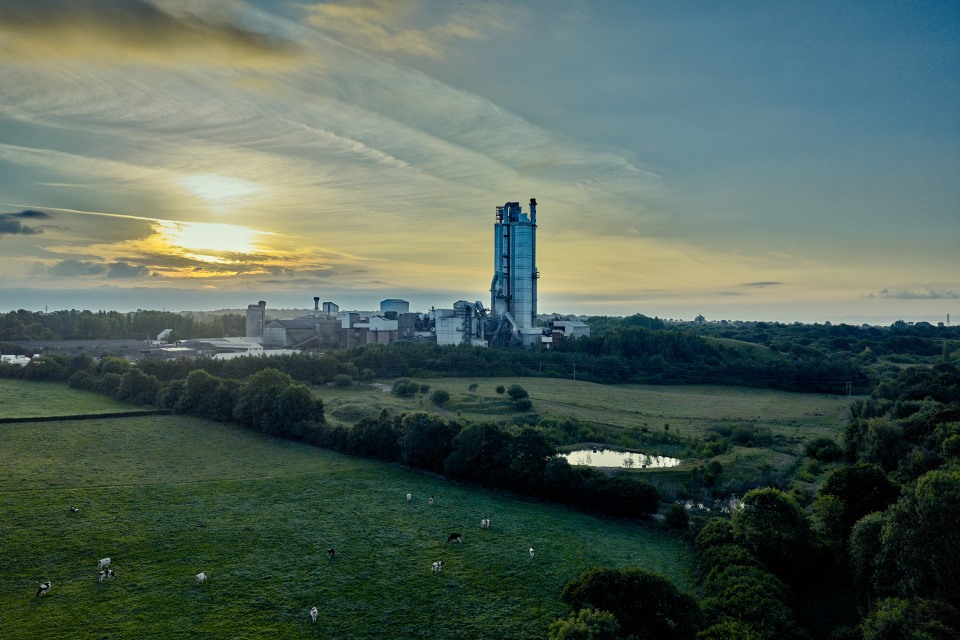
Mitsubishi Heavy Industries, (MHI), together with Worley and Heidelberg Materials, has entered the execution phase of the Padeswood Carbon Capture and Storage (CCS) project in Flintshire, North Wales. The project will be the first in Europe to deploy MHI’s proprietary Advanced KM CDR Process to capture around 800,000 tonnes of carbon dioxide (CO₂) annually from cement production operations at Heidelberg Materials’ Padeswood plant. The CO₂ will be transported via pipeline for permanent storage in depleted gas fields under Liverpool Bay, as part of the HyNet North West cluster.
The news follows Heidelberg Materials’ final investment decision (FID) in September 2025, made in collaboration with the UK Government under Track-1 of its CCUS cluster sequencing program. The new CCS facility is set to be operational in 2029.
MHI and Worley had been awarded a front-end engineering design (FEED) study in 2024. In the execution phase, MHI and its regional representative MHI-EMEA via its London headquarters will provide the engineering and procurement under the Advanced KM CDR Process for the CO2 capture technology, together with other associated plant including compressors. Worley will deliver engineering, procurement, and construction management for the balance of plant.
Cement production is responsible for around 7–8% of CO2 emissions globally. Since most of these emissions come from the chemical process (calcination), they cannot be avoided by switching to clean energy sources. This leaves CCS as the only viable option for fully decarbonized production.
Tatsuto Nagayasu, Senior Vice President (CCUS) of GX (Green Transformation) Solutions at MHI, said, “We are proud to support Heidelberg Materials in realising the UK’s first full-scale carbon capture facility in the cement sector. Using our Advanced KM CDR Process, this project will play a leading role in decarbonising one of the most challenging industrial sectors. Together with Worley, we look forward to delivering this landmark CCS facility that will contribute to the long-term resilience of UK industry and help fulfil the country’s net zero ambitions.”
Simon Willis, CEO at Heidelberg Materials UK, said, “This is the next major milestone in our plans to build the UK’s first carbon capture facility at a cement works. We have established an excellent working relationship with Worley and MHI during the completion of the front-end engineering design (FEED) for our Padeswood project. This, along with their proven track record in delivering this type of complex facility, makes them the perfect partner to take our groundbreaking project to the next stage.”
Chris Ashton, Chief Executive Officer of Worley, said, “This project is a landmark for industrial decarbonisation in the UK and Europe and part of the HyNet carbon capture cluster. We’re proud to be working alongside Heidelberg Materials and MHI to deliver a facility that will help transform cement production and support the UK’s net zero ambitions. Our role in this project reflects our ability to enable sustainable industrial solutions and leverage our global expertise in delivery for complex energy and infrastructure projects.”
The Padeswood CCS project is expected to create approximately 50 new permanent jobs and secure over 200 existing roles, in addition to supporting up to 500 jobs during construction. As part of the HyNet North West cluster, the project will also contribute to building a long-term carbon management infrastructure in the UK, while enabling Heidelberg Materials to supply low-carbon cement to the construction industry.