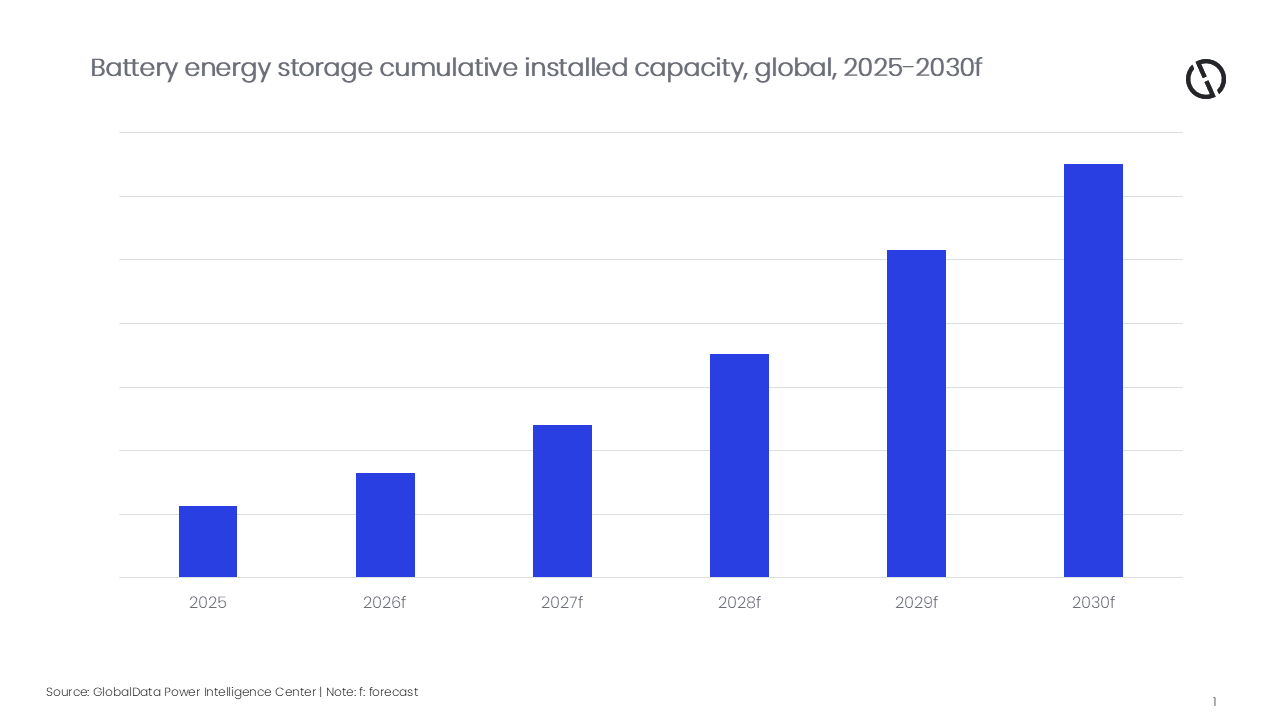
The global battery energy storage system (BESS) capacity is expected to continue to rise to manage growing demand from electrification, industry, and AI/data centres. Moreover, higher proportion of wind and solar increases intra-day variability, imbalance, and curtailment that batteries can mitigate economically. BESS additions are also driven by declining lithium-ion costs, stronger supply chains, and supportive policies. Against this backdrop, the global battery energy storage installed capacity is projected to see a sixfold rise at a compound annual growth rate (CAGR) of 42% from 2025 to 2030, says GlobalData, a leading intelligence and productivity platform.
GlobalData’s latest report, “Strategic Intelligence: Batteries in Power (2026)” reveals that China and the US will remain the dominant players in the global battery energy storage system market. The combined share of the two countries in global BESS capacity stood at 74.6% at the end of 2025, driven by supportive regulatory frameworks, massive utility-scale procurement, and aggressive clean energy mandates.
Rehaan Shiledar, Power Analyst at GlobalData, comments, “The global power sector is increasingly standardising on four-hour battery energy storage systems rather than two-hour designs. Higher shares of solar and wind create longer daily mismatches between generation and demand. It makes multi-hour ‘shifting’, especially moving midday solar into the evening peak, more valuable to reduce curtailment and provide reliable capacity during steep net-load ramps. This is reflected in utility and regulator procurements, which often treat four hours as a minimum for capacity credit and resource adequacy.”
For instance, under California Public Utilities Commission (CPUC) programs, most of the battery projects built have a four-hour duration. Australian state tenders in Victoria and New South Wales specify multi-hour storage to firm renewables. Similar duration-lengthening trends are emerging in the UK as projects shift from frequency-response toward energy and capacity revenues, while the Middle East has contracted multi-hour solar-plus-storage for dispatchable evening output.
Co-located hybrid plants, especially solar-plus-storage, are becoming the default because sharing a single site and interconnection cuts cost and schedule risk. The battery also increases revenue by capturing curtailed solar and shifting delivery into higher-price hours like the evening peak. Co-location also enables export-limited designs where PV is oversized behind a constrained grid tie and excess energy is stored and later discharged without breaching the interconnection limit. Such models are common in California and help meet resource adequacy by providing reliable capacity during peak hours.
In Texas, electricity prices vary widely by location and time, and battery storage can monetise this volatility and enhance system reliability by dynamically charging during low-price periods and discharging when prices spike.
Shiledar adds, “BESS is expected to become a main backup and balancing tool for data centres, moving beyond brief uninterruptible power supply (UPS) support. It actively manages power between the grid and IT equipment, protecting systems from grid problems and on-site power limits. Batteries react in milliseconds, so they can handle sudden voltage or frequency issues and provide instant backup during switchover.”
Batteries can lower costs and work around grid limits by keeping power use within the site’s connection limit, covering short peak loads, cutting demand charges, and smoothing rapid load changes, which helps data centers grow faster where the grid is constrained.
Shiledar concludes, “Energy shifting has become the fulcrum of the battery storage value proposition, recasting batteries from ancillary grid-support tools into system-critical infrastructure. By absorbing surplus renewable output and redeploying it into periods of higher demand and pricing, batteries bolster reliability, curtailment, relieve network congestion, and reduce reliance on peaking generation.
“As costs continue to decline and projects more effectively monetise stacked revenue streams, supported by government mandates, energy shifting will remain the principal catalyst for battery storage deployment and a cornerstone of high-renewables power systems.”