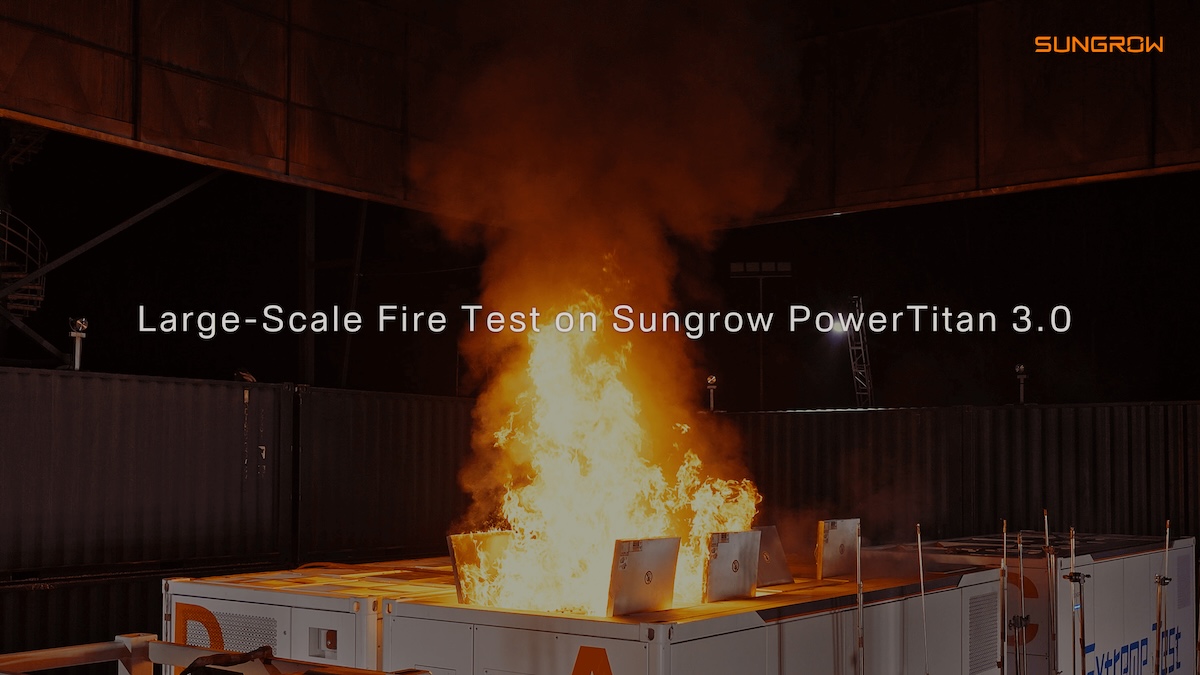
Sungrow, PV inverter and energy storage system provider, announced that its latest PowerTitan 3.0 battery energy storage system (BESS) has successfully completed a large-scale fire test conducted in accordance with the latest applicable requirements of UL 9540A: 2026 and CSA/ANSI C800-2025, making it the industry’s first stacked-cell BESS with an AC-block design to successfully complete such a test. From PowerTitan 1.0 to 3.0, all three generations passed the large-scale fire test on the first attempt.
Conducted by UL Solutions, witnessed by Fire Risk Alliance (FRA), and observed by Jensen Hughes (JH), the test evaluated the system’s ability to contain a severe thermal runaway event and prevent it from propagating to adjacent BESS containers and the Medium-Voltage Substation.
Tested under demanding real-world installation conditions
The test setup replicated the block-level layout of a real-world utility-scale BESS installation, including 28.56MWh of fully liquid-cooled PowerTitan 3.0 BESS and a 7.4MW Medium-Voltage Substation (MVS). PowerTitan 3.0 features high-energy-density stacked cells and an integrated AC block architecture, combining the battery system and DC/AC Power Converter Unit within a single 20-foot container.
To further challenge the system’s safety design, the BESS was at 100% state of charge. The initiating container and the adjacent container were installed back-to-back closely. The MVS was also included in the test configuration. All active fire suppression systems and thermal management system were disabled, and rooftop pressure-relief panels of the initiating container were also fully opened to maximise ventilation and oxygen availability. The test focused on the system’s inherent ability to contain thermal runaway.
All smoke and fire effluent generated during the event were collected and routed through a dedicated purification system. The collected gases were fully treated, with no untreated smoke released directly into the environment.
The test successfully demonstrated that thermal runaway did not propagate from the initiating BESS container to any adjacent containers or the MVS.
The test continued for 7.5 hours under uninterrupted monitoring. The peak internal temperature in the initiating container, identified as Container A, reached 1259.8°C, while the highest cell temperature in the adjacent containers well remained below the threshold for thermal runaway under UL 9540A: 2026.
Despite the intensity and duration of the fire, Container A remained structurally intact. Adjacent Containers B, C, D and E also remained structurally intact, with no deformation. Even after the fire test, the container remained structurally intact and could be lifted as a complete unit.
Under full-charge, close-spacing and maximum-ventilation conditions, the PowerTitan 3.0 contained the thermal event within the initiating container and prevented it from escalating into a multi-container event.
“This test was about verifying our safety design under real-world extreme conditions,” said Roger Li, General Manager of the Utility-Scale Product Line, Sungrow Energy Storage Business Unit. “Safety must be engineered into the product from the beginning. Simulation helps predict how the system will respond, while large-scale fire testing puts those predictions to the test. Energy storage safety is about far more than cell safety alone. It is the result of multiple factors working together, including cell performance, system integration, thermal management, structural protection, engineering design, and more.”