
 With the Future Homes Standard set to drive the adoption of low-carbon heating and higher energy efficiency in new homes, the UK’s housebuilding sector is under increasing pressure to deliver properties that perform as efficiently in practice as they do on paper, writes Ian Rose, Managing Director at Passiv UK.
Heat pumps are set to play a growing role in this transition. Installing these systems, however, is only half the challenge. The real test is whether they continue to perform as intended once the home is occupied.
Too often, problems only come to light when a homeowner finds that their home isn’t warm enough or their energy bills are higher than expected. By that point, systems may have been running inefficiently for weeks or even months.
Without visibility of what is happening inside the home, developers, housebuilders and installers are effectively working blind. As the industry prepares for the Future Homes Standard, remote monitoring is therefore becoming an increasingly important part of delivering efficient, high-performing homes with heat pumps.
New standards require a new approach to performance
The Future Homes Standard represents a significant shift in how new homes will be designed and built, with greater emphasis on energy efficiency and low-carbon heating. But meeting the requirements at the point of construction is only part of the challenge.
For housebuilders and developers, the longer-term question is whether homes continue to perform as intended once they are occupied.
The performance of a heat pump depends on a range of factors, from system settings and flow temperatures to the thermal characteristics of the property and how the system is operated. Without access to real-world performance data, it can be difficult to identify when a system is underperforming or understand why.
Monitoring provides that missing visibility. It allows housebuilders, developers and installers to move beyond simply installing compliant technology and towards understanding how that technology performs in real homes over time.
From reactive to proactive maintenance
At Passiv, we recently launched the Passiv Portal, a free web-based monitoring platform that enables installers to track and manage all their heat pump installations from one dashboard.
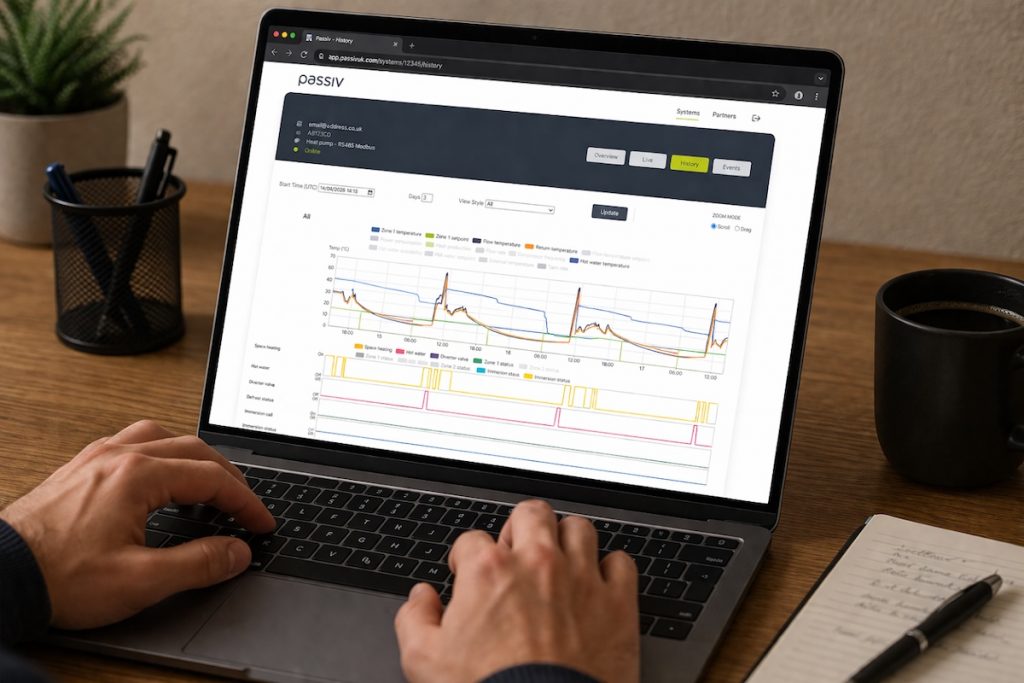
It brings together live and historic performance data – flow temperatures, energy use and system settings – across multiple manufacturers in a single view. That visibility allows installers to understand what is happening in real time.
The shift this enables is important. Instead of waiting for a homeowner to report a problem, installers can spot early warning signs before they become issues.
The result is that homeowners experience fewer disruptions and faster support. Housebuilders and developers can gain greater confidence that heating systems are performing as expected, while installers spend less time travelling to unnecessary call-outs and more time on work that genuinely requires a visit.
For developers, this visibility can also help identify patterns across a development, highlighting where systems may need attention and providing valuable insight into how homes are performing once occupied.
Monitoring is only as good as the control behind it
Of course, monitoring depends on the quality of the data being collected. Controls designed specifically for heat pumps address this by managing flow temperature directly and maintaining more stable system operation.
 The Passiv Smart Thermostat is one example. It optimises flow temperature to keep the heat pump operating in its most efficient range. Verified by the Energy Saving Trust, it can improve heat pump efficiency by 17% and reduce heating bills by up to 30%.
It also factors in weather forecasts, the thermal performance of the home, electricity tariffs and rooftop solar generation to optimise operation automatically. Just as importantly, it generates the operational data that makes meaningful monitoring possible in the first place.
Seeing the whole picture
Few housebuilders or developers are dealing with a single installation or one standardised heating system across every property they deliver. Developments can include a mix of heat pump manufacturers, particularly across projects delivered over several years or by different installation partners. Without a unified system, understanding overall performance becomes slow and inconsistent.
A single dashboard that monitors performance provides that missing overview. It allows installers, developers and housebuilders to compare performance across properties, identify recurring issues, prioritise maintenance and track whether systems are delivering expected efficiencies over time.
This creates a feedback loop that can help the industry learn from real-world performance and continuously improve how low-carbon heating is designed, installed and operated in new homes.
Building homes that perform as intended
The Future Homes Standard marks an important step in the UK’s transition towards more energy-efficient, low-carbon housing. But the success of the standard will ultimately be judged by how these homes perform in the real world – not simply by whether they meet requirements at the point of completion.
That means the industry has to get two things right at the same time: the technology itself, and how it is experienced by the people living with it.
Heat pumps are still relatively unfamiliar to many homeowners, and that can easily shape perception if something doesn’t feel quite right with the heating or running costs.
Having visibility of how systems are operating helps close that gap. It allows installers, housebuilders and developers to demonstrate that systems are working as intended, and to step in early when they are not.
Just as importantly, monitoring can help the industry build a stronger evidence base around the real-world performance of low-carbon homes. As the Future Homes Standard comes into effect, that insight will be essential in ensuring that the homes being built today are compliant, comfortable and fit for the future.