The majority of industrial and commercial (I&C) energy buyers admit their electricity supply arrangements are no longer fit for purpose. But significant barriers prevent them from adopting new strategies – leaving many stuck using outdated models and exposed to uncertainty.
Current electricity procurement models not fit for purpose
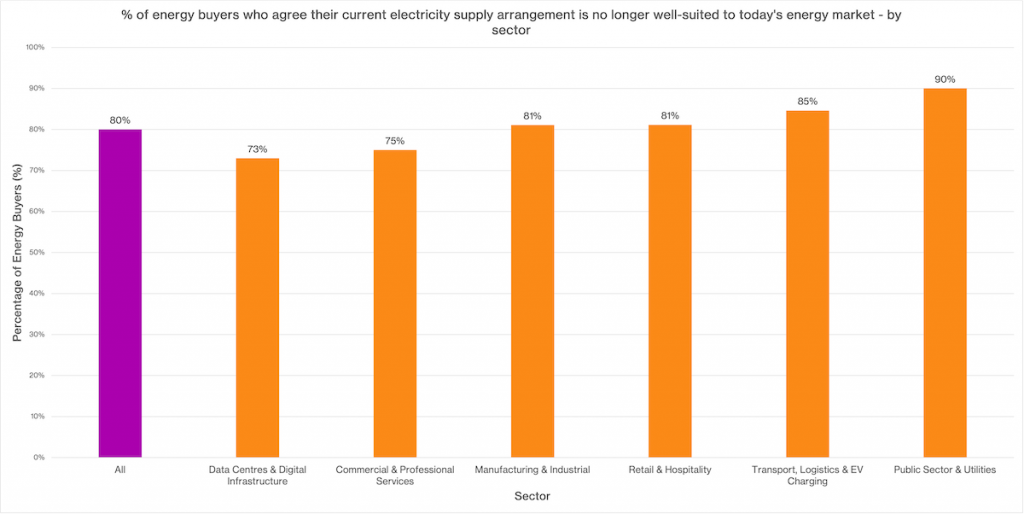
Four in five (80%) I&C energy buyers agree their electricity supply arrangement is no longer well-suited to today’s energy market. Of these, nearly a third (31%) say they strongly agree, according to new, independent research commissioned by SQE* – an energy supply platform for I&C users.
The survey of 200 I&C energy buyers reveals the concern is particularly high in certain sectors. Nine in ten (90%) energy buyers in the public sector agree their electricity supply arrangement is no longer suited to the market, while 85% of buyers in transport, logistics and electric vehicle (EV) charging say the same.
These concerns come at a time when businesses are facing rising system costs. In April 2026, National Energy System Operator (NESO) will introduce substantial increases to Transmission Network Use of System (TNUoS) charges paid by most I&C businesses – the necessary reforms are designed to fund critical upgrades to the UK’s electricity grid as demand rises and more renewable energy is connected.
However, many I&C businesses appear to be unprepared for the coming changes. Fewer than three in 10 (28%) energy buyers surveyed say their business has explicitly budgeted for the upcoming changes to electricity system and network charges. A further 15% say they are aware of potential changes but have not yet incorporated them into budgets.
Energy buyers see risk in sticking with current approach
The survey by SQE suggests that I&C energy buyers increasingly recognise the risks associated with electricity procurement in the current market. More than three-quarters (77%) of respondents say electricity carries significant financial risk for their organisation, with 28% strongly agreeing. A similar portion (76%) believe the way the electricity market operates makes it harder for businesses to manage risk.
The research also suggests that managing electricity risk becomes more complex as the number of sites an organisation operates increases. Energy buyers responsible for 11-50 sites are more likely to say the electricity market makes risk management harder than those managing two to 10 sites (82% compared with 74%).
Alarmingly, 94% of energy buyers say their organisation would face some degree of risk by making no significant change to its electricity approach over the next few years – including 13% who see it as a significant risk, 58% a fair amount of risk, and 24% a small amount of risk.
“Energy buyers are being asked to navigate the 2026 energy landscape with a 2010-era toolbox. Many are stuck in traditional service models, which are no longer fit for purpose,” says Justin Stokes, commercial director, SQE. “These service models treat energy buyers as passive customers when, in reality, they are managing significant financial risk.”
Significant barriers prevent change
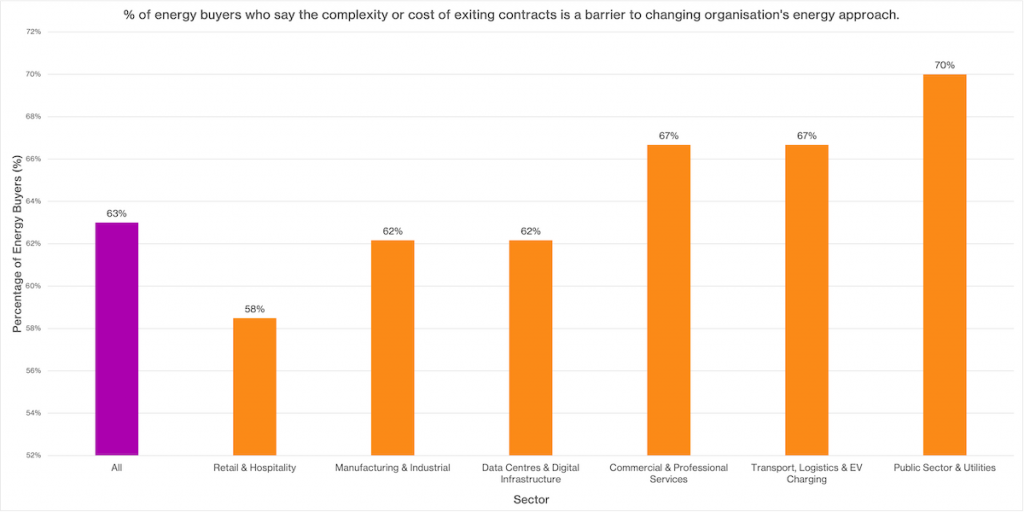
Despite recognising the risks associated with electricity procurement, and the need to adapt the businesses’ electricity strategy, significant barriers are preventing many from doing so. Almost two-thirds of respondents (63%) say the complexity or cost of leaving contracts makes it difficult for their organisation to change its energy approach, with just under three in 10 (27%) describing this as a major barrier.
While uncertainty created by government policy, regulation, or market rule changes is cited by more than three in five (62%) of respondents, with 28% describing it as a major obstacle.
Internal approval and governance processes further slow down decision-making. More than half (55%) say internal processes make it difficult to change energy strategy, and one in five (21%) say these are a major barrier.
Stokes says, “Industrial and commercial energy buyers increasingly recognise that they need to change how they procure electricity, and are more aware of the risks of standing still. However, many still lack the tools and support from their energy suppliers to make that change happen.”
Further analysis of the research results, including key sector findings and expert insight is available here.