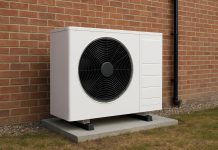

Energised Futures, Centrica’s in-house research and innovation incubator, has partnered with Panasonic in a new pilot designed to advance intelligent heat-pump control. Demonstrating how collaboration across manufacturers, installers and technology innovators can accelerate the shift to smarter, more efficient low carbon heating.
The research has explored the automation and optimisation of heat pumps in Dublin homes as part of an EU funded Horizon-2020 programme – the DEDALUS project – to develop user-centered demand side response (DSR) systems. By combining technical innovation from Energised Futures with Panasonic’s manufacturing expertise alongside local installer partner Mos Mechanical’s on the ground installer insight, the project reflects the full lifecycle of heat pump deployment.
Energised Futures is creating bespoke digital twins for all participating homes and remotely controlling each Panasonic heat pump with predictive algorithms to deliver optimum comfort and efficiency. Building on the success of its earlier MESH project, funded by the Department of Energy Security and Net Zero, the team has developed advanced control algorithms to enable the Panasonic heat pumps to participate in Demand Response. The system prioritises heating the home and hot water tank when electricity is cheap and low‑carbon, while preserving occupant comfort: reducing heat pump operating costs and emissions and simultaneously supporting grid balancing and integration of renewables.
Insights from the Dublin trial will feed directly into complementary pilots in Austria, Denmark, Italy, Spain and Romania, helping to build a holistic understanding of how smart heating and flexibility solutions work across different climates, housing types and energy systems. The overall programme wrapped at the end of April, following which the combined results from Dublin and the other EU pilots will be analysed and shared.
Ben Krikler, PhD, Head of Energised Futures and Director of Research & Innovation, Centrica, emphasised the opportunity ahead, “Heat pumps have incredible potential, but that potential isn’t being fully realised”
“By combining advanced controls, predictive algorithms, and real-world data, we can make heat pumps smarter, more efficient, and more rewarding for households by delivering comfort at the lowest running cost while also helping to balance the grid and reduce emissions.”
Underscoring the wider benefits of the project, Laurence Cox, Country Manager for Panasonic Heating & Cooling Ireland, said, ‘This project highlights the real-world benefits of heat pump technology, from reduced energy costs and improved comfort to lower carbon emissions. We are proud to be working alongside Centrica and MOS Mechanical to help underline the growing importance of proven, low-carbon technologies in supporting the transition to a more sustainable built environment.”
The pilot adopts a user-centric, co-creation approach to understand what drives or hinders participation in demand response, including factors such as comfort, data privacy, and energy literacy. Supported by a robust social science framework and drawing on behavioural science, motivation theories, and socio-economic insights, the project actively involves participants through workshops, segmentation analysis, and interface testing.