
The rapid rise of electric vehicles, heat pumps, photovoltaic systems and batteries is driving the energy transition forward. To unlock their full potential, home energy management systems (HEMS) are crucial for bundling distributed energy resources and making their flexibility available on energy markets. To understand how end consumers want to actively shape this transformation, smart energy company, gridX, conducted a survey to examine their willingness to use smart energy solutions.
In August 2025, gridX surveyed 300 end users who own either an electric vehicle with a wallbox or a photovoltaic system with battery storage (or both), equally split between Germany, the UK and the Netherlands. The results are clear: respondents are highly willing to flexibly adjust their energy consumption in response to market price signals. Financial benefits are the clear driver. 74% of participants cite financial compensation as the main reason for participating in flexibility applications.
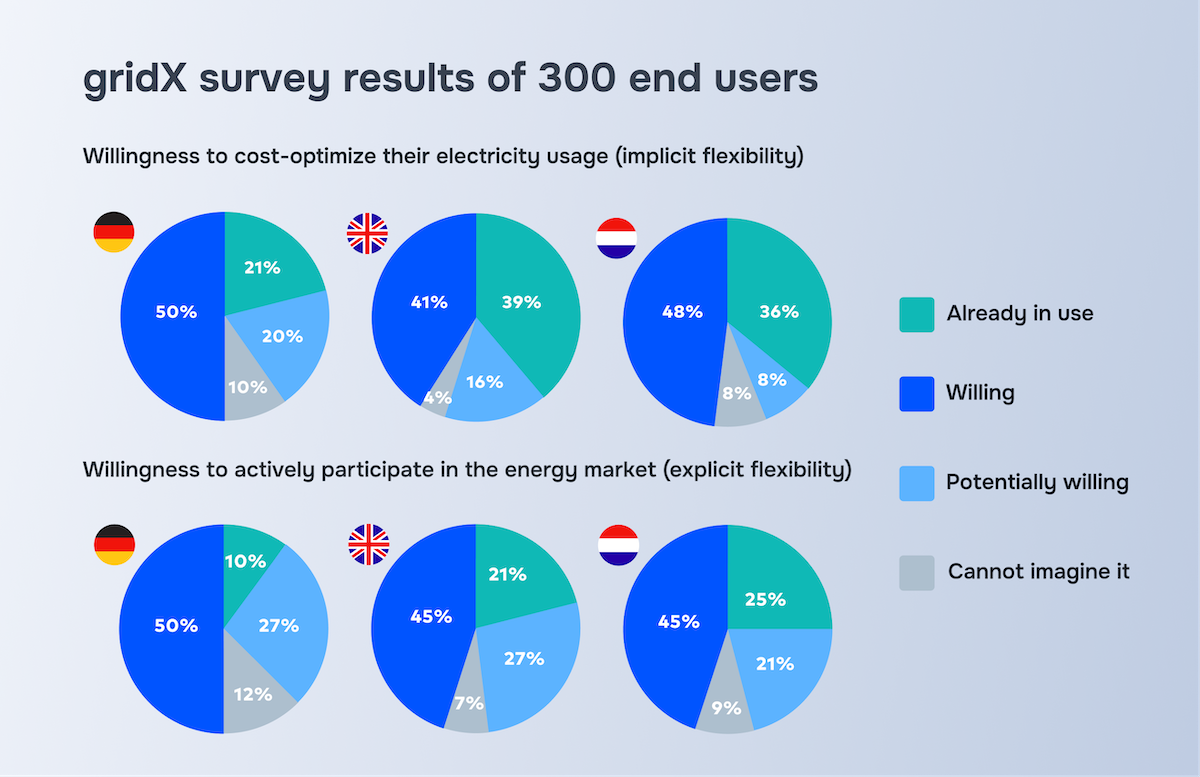
Overall, around one-third already automatically adjust their energy consumption based on energy prices, known as implicit flexibility. British consumers lead the adoption of implicit flexibility (already used by 39%) and also have the lowest share of respondents who can’t imagine using it (4%). This shows that greater market penetration increases user acceptance. Overall, only 18% of respondents have actively participated in explicit flexibility services, where the flexibility of household energy assets is bundled and made available for trading. Adoption is highest in the Netherlands (25%) and lowest in Germany (10%). However, users across all markets remain willing to participate in electricity markets (47% on average), showing that consumer demand is currently outpacing market availability.
High savings potential meets growing market demands
The survey results underscore the growing importance of HEMS solutions that financially incentivise end customers to take an active role in the energy transition. Further analyses from gridX show that a household can save around 1,500 euros per year through intelligent optimisation according to dynamic tariffs, self-consumption and grid signals, in combination with flexibility services. Time-variable grid fees, which enable reduced grid fees for shifting consumption to periods with lower grid congestion, alone provides savings of up to 600 euros. Explicit flexibility services unlock 400 to 800 euros of financial value annually – the ability to combine this with other energy management features is currently under development.
These savings arise from the combination of multiple devices and use cases via an advanced HEMS with a local gateway – the actual amount depends on the respective conditions, such as asset capacity, weather, and personal consumption behavior. gridX’s report also finds that these features will likely deliver greater savings in the future as energy prices become more volatile. By 2040, when the number of hours with negative wholesale electricity prices will have risen dramatically, a Danish household – chosen due to its simplified regulation – could increase its savings by a further 13%, with the same technology already available today. This makes energy management solutions even more lucrative in the long term.
Cloud-to-cloud approach increases efficiency
gridX has also recently implemented a more efficient cloud-to-cloud approach that enables utilities to easily bundle and monetise the flexibility of a pool of electric cars. 2,000 systems have already been implemented in the field. The choice between simple cloud-based optimization and advanced optimisation with a local gateway enables energy sector players to more quickly deploy solutions that leverage the growing potential of ever-increasing energy flexibility. They represent two pathways to turn controllable assets into market reserves that generate revenue by providing capacity to energy markets. The demand for this on-demand flexibility is expected to more than double by 2030. New regulatory requirements in various countries are further shaping this development and forcing companies to turn the changes into competitive advantages.
Autonomy fosters acceptance
gridX’s survey highlights three key concerns of so-called flexumers, i.e., consumers who flexibly shift energy flows to contribute to grid stability: loss of control, low personal benefit, and lack of understanding. More than a third of respondents (37%) are concerned about relinquishing control over their devices. What they perceive as insufficient benefits from participation or a lack of understanding of exactly how flexibility services work inhibits the willingness of many consumers. In addition, more than half of respondents cited a credible and reputable provider as an important product feature. Other important features include low setup costs and an app for easy control. Given these concerns and requirements, it is essential for providers to present themselves as reputable partners who offer full transparency regarding device control and intuitive operation via an app.
Tim Steinmetz, gridX Managing Director, “Our survey and increasing field experience confirm the trends in today’s energy market: flexibility services are rapidly evolving from an innovation to a core component of any energy management solution. gridX is uniquely positioned to support B2B customers with the full spectrum of solutions covering connectivity, energy management and flexibility, and a range of go-to-market strategies. From a simple cloud-to-cloud approach for optimizing electric vehicles, to a gateway-plus-cloud approach for multi-asset households that want to combine grid-compliant control and flexibility use cases – this diversity ensures energy companies can maximize value for every end user.”