
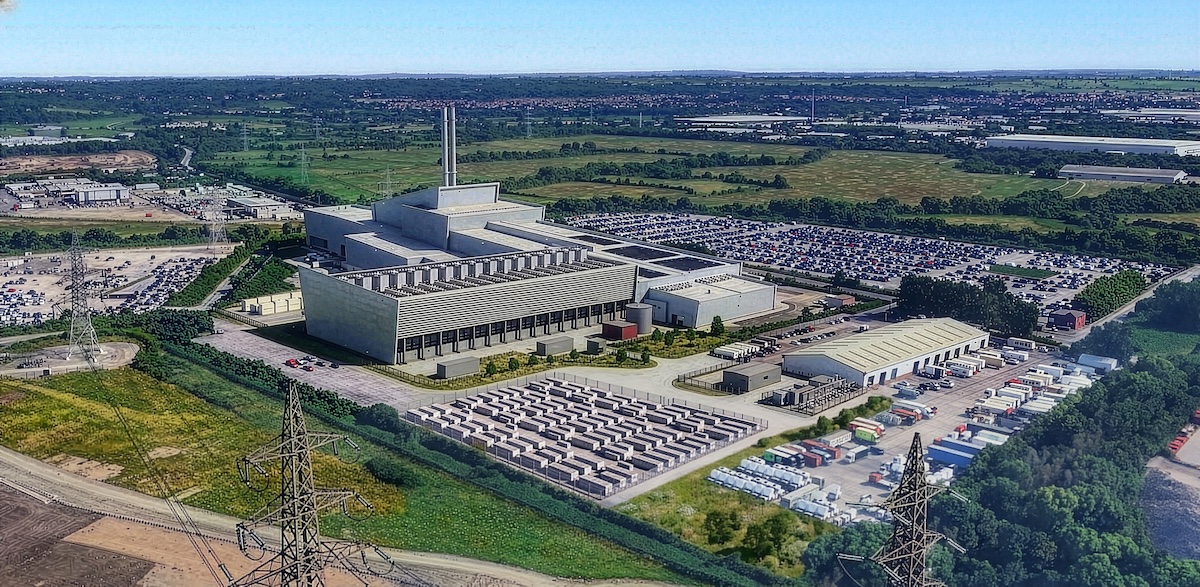
Energy-from-Waste (EfW) facilities could play a significant role in supporting UK industrial growth across regions by providing reliable electricity directly to industrial users and data centres through connections via private wire, according to new research commissioned by Resource Recovery UK (RRUK) and undertaken by global sustainability consultancy ERM.
EfW infrastructure recovers energy as a valuable by-product of managing the nation’s non-recyclable waste. The UK’s existing fleet already provides around 1.7GW of reliable baseload power to the electricity market, while some facilities also supply waste heat directly to nearby homes and businesses.
This research identifies a clear opportunity for EfW to maximise the value from this recovered energy by connecting nearby industrial users and rapidly expanding data centre businesses via private wire arrangements. Through import arrangements with the distribution network operator, EfW facilities can also offer an effective ‘bridge’ to the grid via the EfW’s own grid connection, ensuring reliable access to power via the same infrastructure.
With huge demand for industrial electrification and AI-driven data centre expansion creating a growing challenge for available grid headroom, the report finds that private wire connections could unlock connections more quickly and ease pressure on constrained parts of the grid. The research finds that:
- More than half of existing data centres are located within 10km of an EfW plant, equivalent to 350MW of reliable power, with clusters across London and other major cities including Birmingham, Leeds, Sheffield and Nottingham.
- There is an even stronger longer-term opportunity for EfW to support demand in this area, as data centre roll-out is set to follow existing locational trends and grow nearly four-fold by 2030.
- More than 500MW of electricity could be supplied to industrial users facing future grid constraints particularly within food & drink, chemicals and paper manufacturing.
- Unlike conventional grid connections, which can take seven to twelve years for larger projects, private wire connections could typically be delivered within two to four years, providing businesses with faster access to reliable power, supporting investment into the UK.
- EfW private wire connections can offer improved price certainty for businesses via long-term bilateral agreements.
Case study: Viridor and Rivington Energy putting the model into practice
RRUK member Viridor and Rivington Energy have joined forces to develop up to 200MW of AI-ready data centre capacity. The data centres will be co-located with several of Viridor’s EfW facilities across the UK, including in Greater London, Oxfordshire and Fife.
The first project in Avonmouth, Bristol, would deliver 40MW of compute capacity and could be operational as early as 2027.
Mike Maudsley, Chair of RRUK and CEO of enfinium said, “Energy-from-Waste already generates reliable energy as a by-product of managing the UK’s non-recyclable waste. Private wire connections present a huge opportunity to go further: responding to the surge in demand for connections from data centres and other industries. EfW facilities can help local businesses get connected much faster, providing reliable power and long-term price certainty, and, crucially, making the most of existing infrastructure that’s already in place.”
Silvian Baltac, Lead Partner at ERM, said, “The challenge of securing reliable power is now a critical issue for many industrial businesses and data centre developers. We increasingly see projects delayed not by a lack of demand, but by the availability and timing of grid connections. This analysis highlights a significant opportunity for the UK’s EfW sector to help bridge that gap. Faster private wire connections can support investment, accelerate industrial electrification and reduce emissions, as well as help unlock growth in some of the country’s most grid-constrained regions.”
Andrew Newman, Executive Director at Rivington Energy, Viridor’s partner in developing AI-ready data centres across its EfW sites, said, “This report highlights the opportunity to use existing energy infrastructure to accelerate the UK’s digital growth. Our partnership with Viridor shows how that can work in practice, combining reliable local power with next-generation data centre expertise. As demand for AI infrastructure grows, this is a practical way to bring new capacity online faster.”