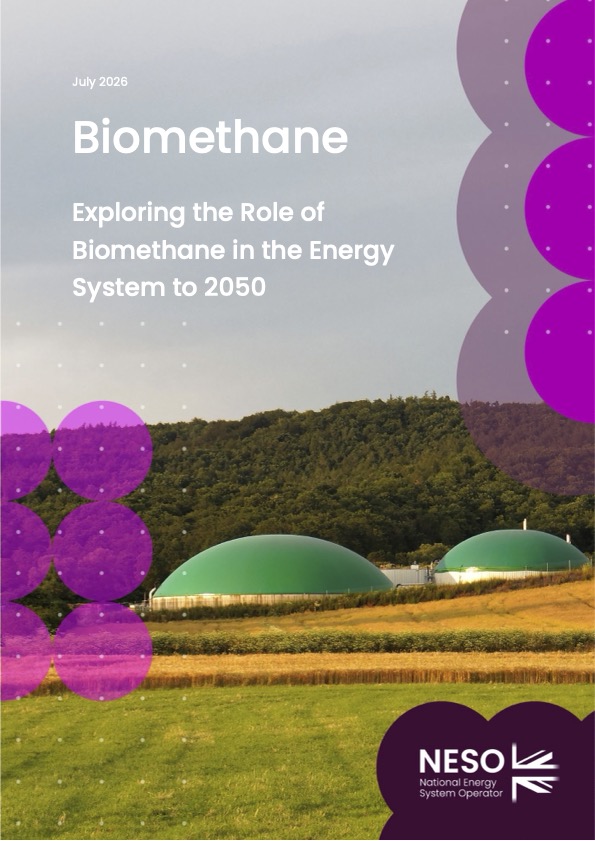
On 30 July 2026, the UK’s National Energy System Operator (NESO) released its report: Exploring the Role of Biomethane in the Energy System to 2050.
Future Biogas is at the forefront of the biomethane industry. In 2025, it launched the UK’s first unsubsidised biomethane plant, generating green gas for AstraZeneca and capturing CO2 for food and drinks manufacturing. It also operates a further portfolio of 10 plants across the UK which today accounts for approximately 10% of the biomethane injected into the UK gas network. Interviews and site visits are available, on request.
Philipp Lukas, CEO of Future Biogas who has served as board member of the European Biogas Association, co-chair of the EU Commission’s Biomethane Industrial Partnership, and member of the UK Renewable Energy Association’s Green Gas Steering Group, says, “NESO’s report reinforces something that the industry has long realised: Britain will need more than one route to net zero. Electrification will do much of the heavy lifting, but it cannot do everything. Biomethane has a critical role to play in decarbonising the hardest to abate sectors, strengthening energy security and providing the flexible, low-carbon energy system the UK will need in the decades ahead.
NESO’s Future Energy Scenarios already point to biomethane production growing to around 64 TWh by 2050 – around ten times today’s production, and this report shows the first 30TWh of that growth can be done with very low risk. That 30 TWh represents a five-fold increase on what the UK is feeding into the gas networks today. As one of the UK’s leading biomethane producers, we welcome this recognition of the strategic role renewable gas can play.
Scaling sustainably is just as important as scaling quickly. At Future Biogas, we’re already working with hundreds of British farmers to integrate energy crops into diverse crop rotations that support soil health, improve farm resilience and complement food production, while returning nutrient-rich biofertiliser back to the land. That’s exactly the kind of sustainable growth the UK needs to be encouraging.
The next step is turning ambition into delivery. The industry is ready to move. Government now has an opportunity to provide the long-term policy certainty that gives investors’ confidence to build new capacity and enables businesses to secure long-term supplies of British-produced biomethane. With the right framework, the UK can accelerate investment, strengthen domestic energy security and unlock one of the country’s most valuable low-carbon energy resources.”
Dr Nick Primmer, Head of Policy and ESG at Future Biogas, Vice chair of the Renewable Energy Association’s Green Gas Forum, Chair of the Sustainable Bioenergy Crop Working Group and lead author of the World Biogas Association’s Pathways to 2030 report, adds, “NESO’s report demonstrates that sustainably produced biomethane has a major role to play in Britain’s future energy system. Produced from British farms, biomethane can strengthen energy security, support resilient food production through regenerative crop rotations and help decarbonise sectors where a molecular fuel is still required. Biomethane makes the energy transition cheaper and more achievable.
“The challenge now isn’t whether biomethane has a role, it’s creating the market conditions that allow it to scale. NESO rightly highlights the need for long-term policy certainty. One of the clearest opportunities is reform of the UK Emissions Trading Scheme (UK ETS). Across Europe, grid-injected biomethane can already be recognised within emissions trading, helping businesses decarbonise while stimulating investment in new renewable gas production. The UK must not fall behind. Failure to act puts UK industry and growth at risk.
“The right policy framework would do far more than support biomethane producers. It would create the confidence corporate energy users need to sign long-term procurement agreements, unlocking billions of pounds of private investment in new UK energy infrastructure while reducing industrial emissions.”
Key findings of NESO’s report
1. Biomethane has a strategic long-term role in the UK’s energy system
NESO concludes that biomethane can deliver significant value by:
- decarbonising hard-to-electrify sectors such as industry and parts of transport;
- providing flexible, low-carbon power generation that supports a resilient electricity system;
- offering one of the UK’s lower-cost routes to permanent greenhouse gas removals through carbon capture and storage;
- helping reduce the overall cost of delivering net zero by making use of existing gas infrastructure.
- The UK has significant potential to grow biomethane production
NESO finds that:
- sustainable biomethane production could increase substantially beyond today’s levels, with around 30 TWh achievable before major sustainability trade-offs become significant (5x that of today);
- higher production volumes are possible, although challenges such as feedstock availability, grid infrastructure and competing uses become increasingly important;
- its Future Energy Scenarios explore pathways of up to 64 TWh of annual biomethane production by 2050;
- realising this potential will require coordinated action across agriculture, energy and industry.
- Policy will determine whether that potential is realised
NESO calls for Government to take a more strategic approach by:
- setting a clear ambition for sustainable biomethane production;
- identifying the sectors where biomethane delivers the greatest whole-system value;
- implementing policies that stimulate long-term investment and enable corporate procurement of sustainable biomethane;
- giving investors and corporate energy users the confidence to support new biomethane production and associated infrastructure.
Why this matters
NESO’s report marks an important shift in the national conversation. The question is no longer whether biomethane has a role in the UK’s energy transition, but how Government and industry work together to scale production sustainably and deploy it where it delivers the greatest value.
For organisations with long-term energy or decarbonisation strategies, the report provides growing confidence that biomethane will play an increasingly important role in the UK’s future energy system.
Long-term partnerships between biomethane producers and corporate energy users can help bring forward new production capacity, accelerate decarbonisation and strengthen domestic energy security.