 Two compliance duties, one set of meter readings and three dates in the next twelve months. Getting the data right this winter makes both easier, and strengthens the case for efficiency projects that cut bills explains Adam Elder, Director at ADM & Partners, a commercial energy and sustainability advisory working with UK businesses.
Much of the business energy conversation lately has been about what to buy and where to generate it. But the cheapest kilowatt hour is still the one a site never uses, and two pieces of regulation put that question in front of company boards: the Energy Savings Opportunity Scheme (ESOS) and Streamlined Energy and Carbon Reporting (SECR).
They are easy to treat as one job. They are not, but they can share most of the groundwork.
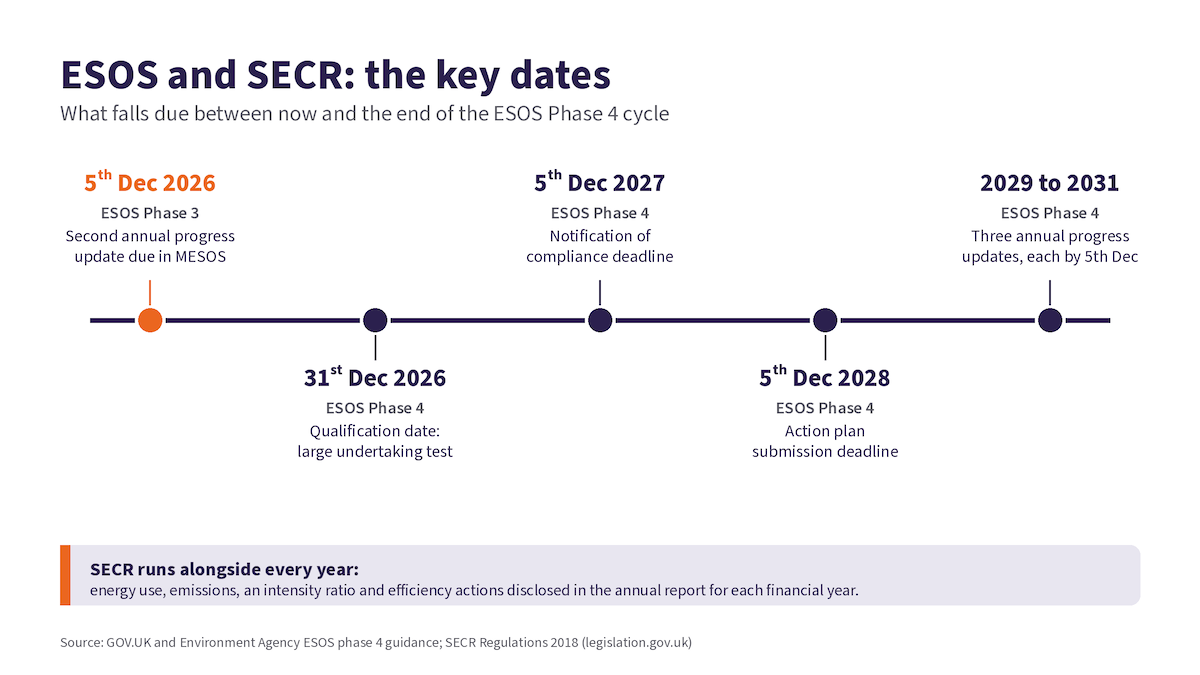
Three dates to put in the diary
5th December 2026. Organisations that qualified for ESOS Phase 3 and submitted an action plan have a second annual progress update due through the Environment Agency’s MESOS system. It reports the measures implemented and an estimate of the energy saved between 6th December 2025 and 5th December 2026, and it needs board-level sign-off. The regulators say they will not take enforcement action over a missing action plan or progress update, but any failure to submit will be published.
31st December 2026. This is the qualification date for Phase 4. An organisation is in scope if, on that day, it or any UK company in its group is a “large undertaking”: 250 or more employees, or annual turnover above £44 million and a balance sheet total above £38 million. Businesses near those lines, or that have recently grown or shrunk, should check section 1.6 of the Environment Agency’s Phase 4 guidance.
5th December 2027. The Phase 4 notification of compliance deadline. Missing it, or skipping the assessment, risks civil penalties and publication.
Where the two duties overlap, and where they don’t
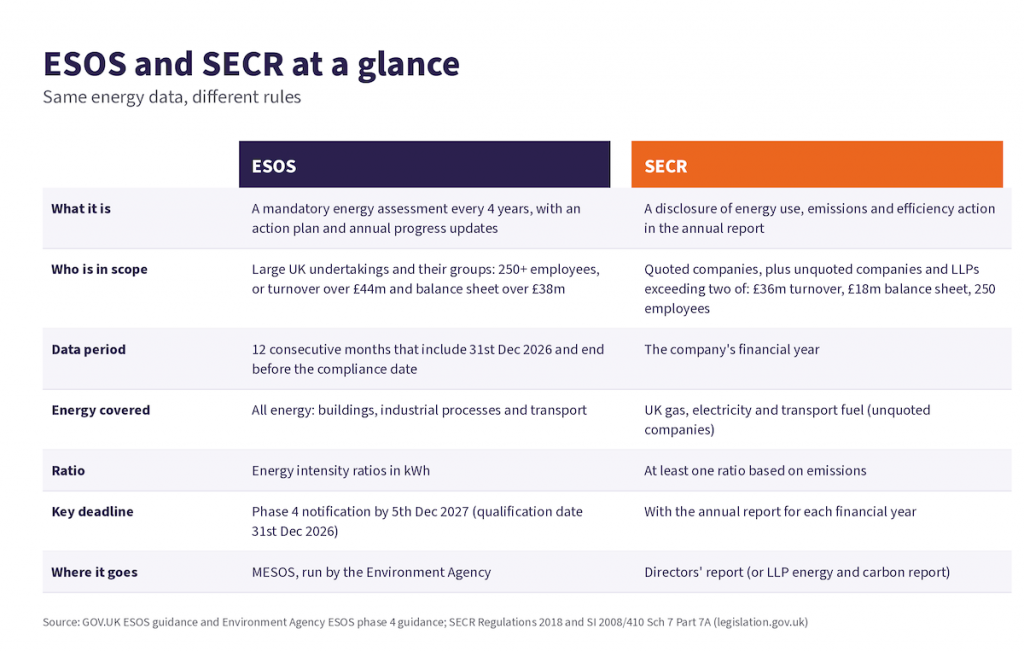
ESOS asks qualifying organisations to measure total energy use across buildings, industrial processes and transport over a reference period of 12 consecutive months. That period must include 31st December 2026 and end before the compliance date. At least 95% of that consumption must then be covered by energy audits or ISO 50001 certification.
SECR, in force since 1st April 2019, is a disclosure in the annual report. It applies to quoted companies, and to unquoted companies and LLPs that exceed two of three limits: turnover of £36 million, a balance sheet total of £18 million and 250 employees. In-scope unquoted companies report UK energy use from gas, electricity and transport fuel, the associated emissions, at least one intensity ratio, their methodology and the principal energy efficiency measures taken in the year.
The practical differences:
- The period. SECR follows the financial year. ESOS needs a 12-month window that spans 31st December 2026. A business with a calendar year-end can use the same twelve months for both.
- The scope. ESOS takes in every energy supply, not just the fuels SECR asks about. The guidance warns that data gathered for other schemes is unlikely to be enough on its own.
- The ratios. ESOS energy intensity ratios are measured in kWh. The SECR ratio is expressed in emissions.
- The thresholds. ESOS and SECR use different size tests, so being in one does not automatically mean being in the other.
The Environment Agency’s guidance is clear that systems used to collect and audit energy data for ESOS, and progress on ESOS recommendations, can help organisations meet SECR. It does not work the other way round. SECR reporting does not count as ESOS compliance.
From compliance to energy management
The part of ESOS that pays for itself is the audit: done well, it shows where energy goes and which measures are worth funding. Phase 4 also raises the bar on follow-through. The ESOS report now has to review the previous action plan, identify measures that have not been, and will not be, implemented by 5th December 2027, and explain why.
So this winter is a good moment to go back to basics. Are the half-hourly data, sub-meters and fuel records good enough to show what changed after each project? Can the site team point to the out-of-hours load or heating schedule that was fixed, and the kWh it saved? If the answer is “roughly”, the evidence pack will struggle, and so will the SECR narrative.
A checklist to work through now
- Phase 3 update. If you submitted a Phase 3 action plan, confirm the second progress update is signed off and in MESOS before 5th December 2026.
- Group test. List every UK company in the group and check each against the ESOS large undertaking test as at 31st December 2026.
- Pick one 12-month window. Choose a reference period that includes 31st December 2026 and, where possible, matches your SECR financial year.
- Gather verifiable data. Invoices, meter readings, half-hourly data and fuel card records for every site and vehicle. Record how any gaps are estimated.
- Find the 95%. Identify your areas of significant energy consumption early, so site visits can be planned.
- Book the lead assessor. Unless your energy use is under 40,000 kWh or covered by ISO 50001, an approved lead assessor must review the assessment.
- Review the old action plan. Note which measures were delivered, which were dropped, and why, ready for the Phase 4 report.
- Keep one measures register. Record each efficiency project, the site, the date and the estimated saving. It feeds ESOS and SECR alike.
- Diary the board. Phase 4 needs director sign-off. So does your annual report.
- Start the evidence pack. Phase 4 records must be kept until 5th December 2035.
What to watch
The government’s 2026 post-implementation review of SECR recommends keeping the regime, with amendments, and points to a planned consultation on streamlining energy and emissions reporting. Nothing has changed in law yet.
None of this is glamorous. But clean meter data and an honest record of what has been done are the foundations of good energy management, whatever the regulation is called.
Sources:
- UK: Energy Savings Opportunity Scheme (ESOS): find out if you qualify and how to comply
- Environment Agency: How to comply with ESOS phase 4 (published 30th July 2026)
- UK: Environmental reporting guidelines, including Streamlined Energy and Carbon Reporting requirements
- The Companies (Directors’ Report) and Limited Liability Partnerships (Energy and Carbon Report) Regulations 2018
- The Large and Medium-sized Companies and Groups (Accounts and Reports) Regulations 2008, Schedule 7, Part 7A
- UK government: 2026 post-implementation review of the SECR regulations 2018