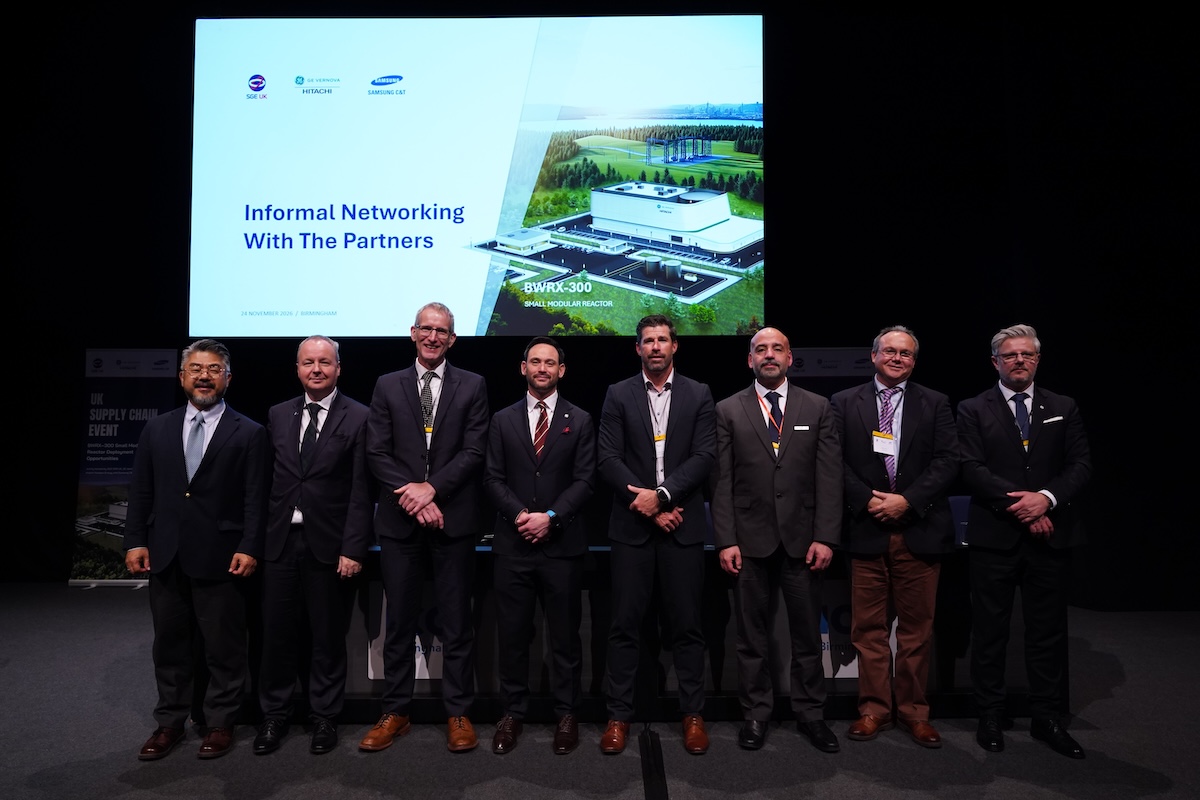
SGE SMR UK, GE Vernova and Samsung C&T Engineering & Construction (E&C) Group yesterday brought together leading British manufacturers, engineering and construction companies, technology providers and specialist suppliers to help shape the detail of its UK supplier strategy. The event explored specialist UK capabilities, the role these can play in the development of UK and European fleets and what businesses need in order to grow in support of the proposed £35bn programme of BWRX-300 small modular reactors.
In July this year, SGE SMR UK submitted a proposal to the Department for Energy Security and Net Zero under the UK Government’s Advanced Nuclear Framework for the deployment of 14 BWRX-300 reactors across three UK sites, representing approximately 4.2GW of new nuclear capacity. With first power targeted for 2034, the full project will meet around 11% of current UK consumption, equivalent to powering eight million homes for 60-80 years. The proposal has progressed to the Preliminary Regulatory Assessment Deep Dive. In total, SGE estimates the entire programme will attract approximately £35bn of investment.
The supply chain event, held in Birmingham on 24 November and jointly hosted by SGE SMR UK, GE Vernova Hitachi Nuclear Energy and Samsung C&T, brought together over 200 companies from across British industry. Among the speakers was Tom Greatrex, Chief Executive of the Nuclear Industry Association (NIA), who highlighted the significant opportunities the proposed programme presents for the UK nuclear supply chain and the wider industrial sector. As part of the ongoing engagement with British suppliers, discussions focused on how UK businesses could participate in the development, construction and long-term delivery of the proposed fleet. Attendees also included representatives from the UK Department for Energy Security and Net Zero (DESNZ) and the Department for Business, Innovation, Science and Trade (BIST).
The engagement reflects the progress already made by SGE SMR UK and its partners in developing its plans beyond its initial UK proposal and forms part of a broader programme of activity to understand specialist UK capabilities and the practical requirements for delivering a repeatable nuclear fleet at scale. The programme is based on a fleet deployment model, with successive projects drawing on a standardised reactor design, common supply chain and shared delivery framework. This approach is intended to support repeat construction, reduce delivery risk and enable experience and expertise to be transferred between projects.
A key ambition for the programme is to maximise the opportunity for British industry as the fleet develops. The Birmingham event gave UK companies that could potentially contribute to the future construction and delivery of the reactors an early opportunity to understand the programme, engage directly with the organisations behind it and consider the capabilities and nuclear readiness that would be required to participate.
Delivering a fleet of this scale will draw on expertise from every part of the UK’s industrial base, from design, engineering and manufacturing through to construction, operations and long-term fleet support. Opportunities would span nuclear and civil engineering, advanced manufacturing, welding and fabrication, electrical and control systems, quality and safety assurance, project delivery and logistics. By manufacturing major components in factories before deployment, the programme would also help strengthen UK precision engineering and fabrication capabilities, creating opportunities for businesses across the country to support UK deployment. SGE SMR UK has formed a UK subsidiary and expects to open a UK office with local staff by the end of the year.
Rafał Kasprów, CEO of SGE, said, “Our ambition is not simply to build individual reactors, but to establish a fleet programme that can be delivered repeatedly and efficiently in the UK. British industry has a critical role to play in making that possible.The UK has a highly skilled workforce and a strong industrial and nuclear heritage. Our ongoing engagement with suppliers across the country is helping to shape the detail of our UK supplier strategy and identify how British businesses can contribute to fleet delivery at scale, ensuring that investment in new nuclear creates opportunities throughout the UK supply chain. Standardisation, repetition and a fleet-based approach are fundamental to our plans for the BWRX-300. Building a strong domestic supply chain alongside that model will be equally important as we work to turn our proposal into a major British infrastructure and industrial programme.”
“The UK has a well-established nuclear industry and a strong base of engineering and manufacturing expertise. Engaging early with UK suppliers is important to align their capabilities and explore how they could contribute to future BWRX-300 projects, both in the UK and across Europe. At GE Vernova Hitachi, we recognise that building a qualified, competitive supply chain is an essential part of developing a sustainable nuclear industry, and we welcome the opportunity to contribute our technology and experience to these discussions,” said Andy Champ, Advanced Nuclear Market Development Leader for Europe.
This event is the latest step in SGE SMR UK’s ongoing supplier engagement as we develop the supply and delivery strategy for the SMR fleet, with the full plan expected to be finalised in 2027.
The BWRX-300 is a 300MWe SMR built on decades of proven boiling water reactor (BWR) operating experience. Its simplified, innovative design reduces capital costs and construction timelines, positioning it as the leading SMR technology ready to deliver reliable, carbon-free energy at scale in in the United Kingdom and across Europe. Beyond clean electricity, the BWRX-300’s combined heat and power (CHP) capabilities offer a vital competitive edge for European heavy industry providing high-temperature thermal energy to decarbonise sectors such as chemical processing, hydrogen production and district heating. The first BWRX-300 is already under construction at Ontario Power Generation’s Darlington site in Canada, providing a reference for future deployments in Europe.