
 Energy procurement remains fundamental to the TPI proposition, but customers increasingly expect more than a competitive contract every few years. Josh Coleman, Head of Indirect Channel at Tritility, explains why better use of energy data could help consultants build deeper, more valuable customer relationships.
For many businesses, the traditional relationship with an energy consultant was relatively straightforward. As a contract approached renewal, the TPI went to market, compared supplier offers and helped the customer secure its next deal.
That remains an important part of the consultant’s role, but according to Tritility’s Head of Indirect Channel, Josh Coleman, it is no longer enough on its own.
“Customers are much more sophisticated than they’ve ever been before,” says Coleman. “They understand the market more and they expect more from a consultant.”
One of the biggest drivers has been cost.
Energy was already a significant overhead for many organisations, but the extreme volatility experienced since the pandemic pushed it much higher up the boardroom agenda.
As a result, businesses are increasingly looking beyond what they pay for each unit of energy and asking what can be done during the life of the contract to reduce the overall bill.
That creates a much broader role for the TPI.
Rather than waiting 24 or 36 months for the next procurement exercise, consultants can help customers examine when they consume energy, how much they use and whether behaviour or operational changes could reduce costs.
Available capacity is one example. A business may be paying for considerably more capacity than it actually uses without routinely examining whether that level remains appropriate. Consumption patterns, fixed charges and other elements of the bill can similarly provide opportunities that have little to do with renegotiating the commodity price.
For Coleman, these are exactly the conversations that can move the TPI relationship beyond procurement.
From a three-year conversation to an ongoing relationship
There is also a commercial benefit for the consultant.
“If you speak to a customer only every three years, there’s an inherent amount of risk there,” says Coleman.
A consultant who disappears after the contract is signed and reappears at renewal has relatively few opportunities to demonstrate their value. Regular engagement changes that dynamic.
Helping customers understand consumption, identify potential savings or assess new technologies creates reasons for the TPI and customer to speak throughout the contract.
When renewal eventually arrives, the procurement exercise becomes one part of an established relationship rather than the point at which the relationship has to be re-established.
The challenge is giving consultants the information to have those conversations.
Making half-hourly data useful
This is one of the areas Tritility is targeting through its Envisij platform.
Half-hourly customers already generate large quantities of consumption data, but access to data and being able to use it effectively are two different things.
Presented as thousands of figures in a spreadsheet, half-hourly data can be difficult for a busy business manager to interpret.
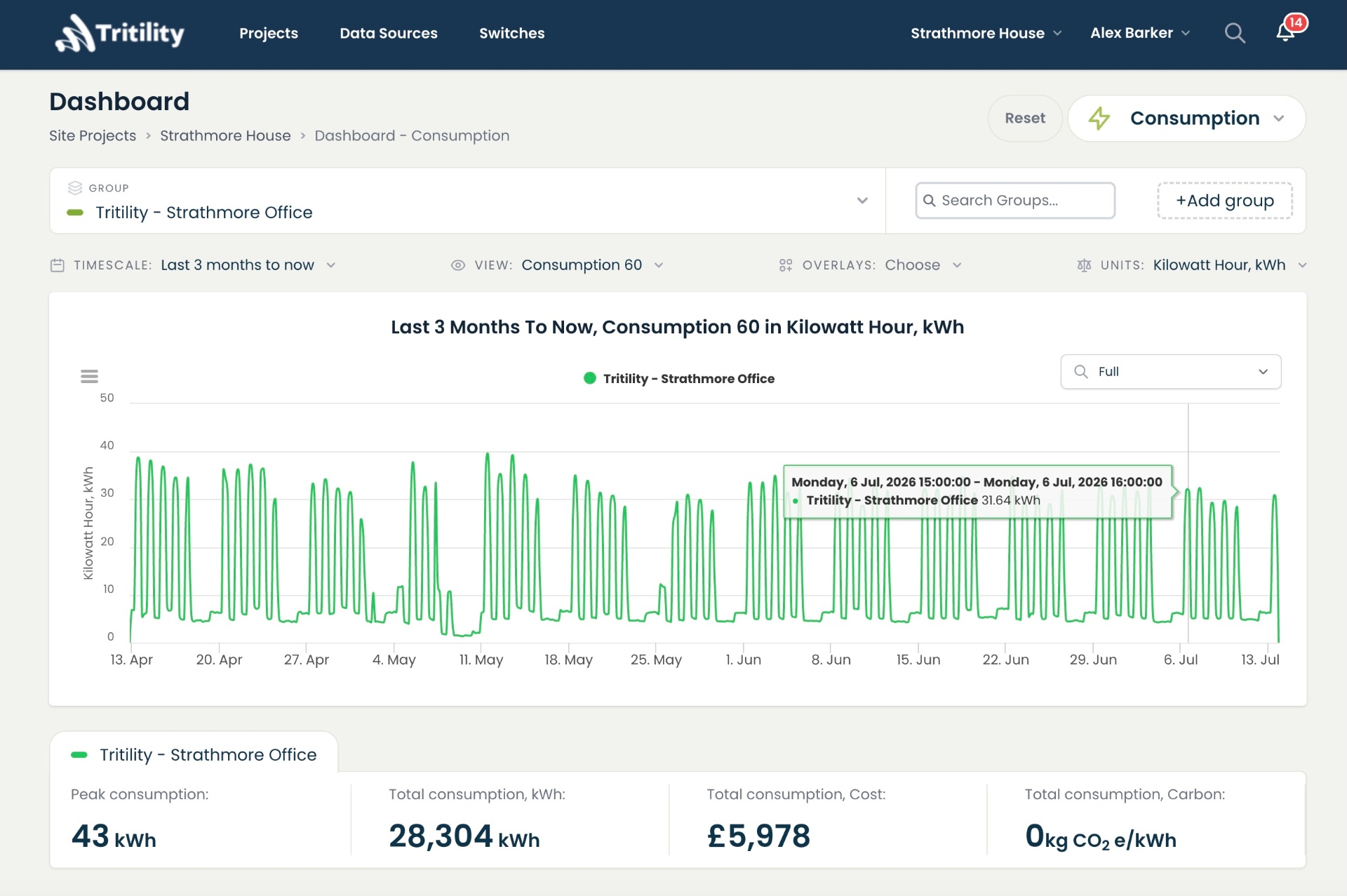
Envisij is designed to visualise that information so both the TPI and customer can more easily understand what is happening across a site.
Opening hours can be overlaid against consumption, for example, making it easier to identify energy being used when a building should be largely inactive. Weather information can also be considered alongside consumption to help explain changes in demand.
Sometimes the insight can be relatively simple.
A customer that assumes everything is switched off overnight may discover a persistent baseload. That could point towards machinery being left running, automated controls operating incorrectly or equipment consuming substantially more energy than expected.
At a more granular level, additional metering can allow consumption to be examined at circuit or equipment level, helping businesses move from knowing that a site is consuming too much energy to identifying the process or piece of equipment responsible.
The value is not simply in displaying the information, Coleman argues, but using it to make decisions.
Could a process be moved by half an hour? Could equipment start later or switch off automatically? Is a particular load necessary during an expensive period?
Individually those decisions may appear relatively small. Across a site and over a year, they can become significant.
Building the business case
Better data can also help businesses decide whether more substantial energy investments actually make sense.
Battery storage is a good example.
For a site that cannot move consumption away from expensive periods because of operational requirements, storage could potentially allow electricity to be drawn from the grid at a different time and used during peak periods.
But the technology is not automatically appropriate for every business.
Detailed consumption data allows the TPI and customer to examine the load profile and build a more credible business case before committing to what could be a significant capital investment.
The same principle can apply to other energy projects: understand how and when the site uses energy first, then determine which intervention is appropriate.
That potentially puts the TPI in a valuable position between procurement, energy management and investment decisions.
Technology without building the technology
For smaller consultancies, developing their own sophisticated customer portal and data-analysis platform may be unrealistic.
Tritility therefore makes Envisij available as a white-labelled proposition. The TPI can access its portfolio of customers through the platform and, if it chooses, give individual customers access to their own information.
That means a smaller consultancy can potentially offer technology and insight more commonly associated with a much larger energy-management operation without developing the infrastructure itself.
But Coleman is keen that technology should not replace the consultant.
Some customers will log into a portal and interrogate the data themselves. Others will not have the time, expertise or inclination.
For those businesses, the greater value may come from the consultant interpreting the information and sitting down with them to explain what it means and what they could do differently.
That human element is important because energy is rarely the sole responsibility of the person dealing with it. In many organisations, particularly in the mid-market, energy sits alongside a host of other responsibilities.
Procurement remains – but expectations are changing
None of this means procurement has become less important.
An experienced TPI can still access a broader supplier market, understand different contract structures and help a customer assess options that would be difficult and time-consuming to navigate alone.
But procurement is increasingly becoming one element of a wider service.
As Coleman puts it, simply turning up at renewal is becoming harder to differentiate when competitors may already be offering customers procurement alongside consumption analysis, sustainability support and wider energy-management services.
For TPIs, that should be viewed as an opportunity rather than a threat.
The consultant who can help a business understand not only what it pays for energy, but when it uses it, why it uses it and what it can do differently, has considerably more reasons to remain part of the customer’s business between contract renewals.
And that may ultimately turn the traditional energy broker into something much harder for a customer to replace: an ongoing energy-management partner.
Envisij clarifies where energy’s being wasted
 One international logistics business, operating sites across several countries, had struggled to see where energy was being wasted. Using Envisij, it found outdated machinery and equipment running outside business hours, and the changes it made are expected to deliver a first-year benefit of around £300,000.
None of that required a new energy contract,” says Coleman. “It came from understanding how the sites were actually using energy, and that’s a conversation a consultant can have at any point in the contract.