
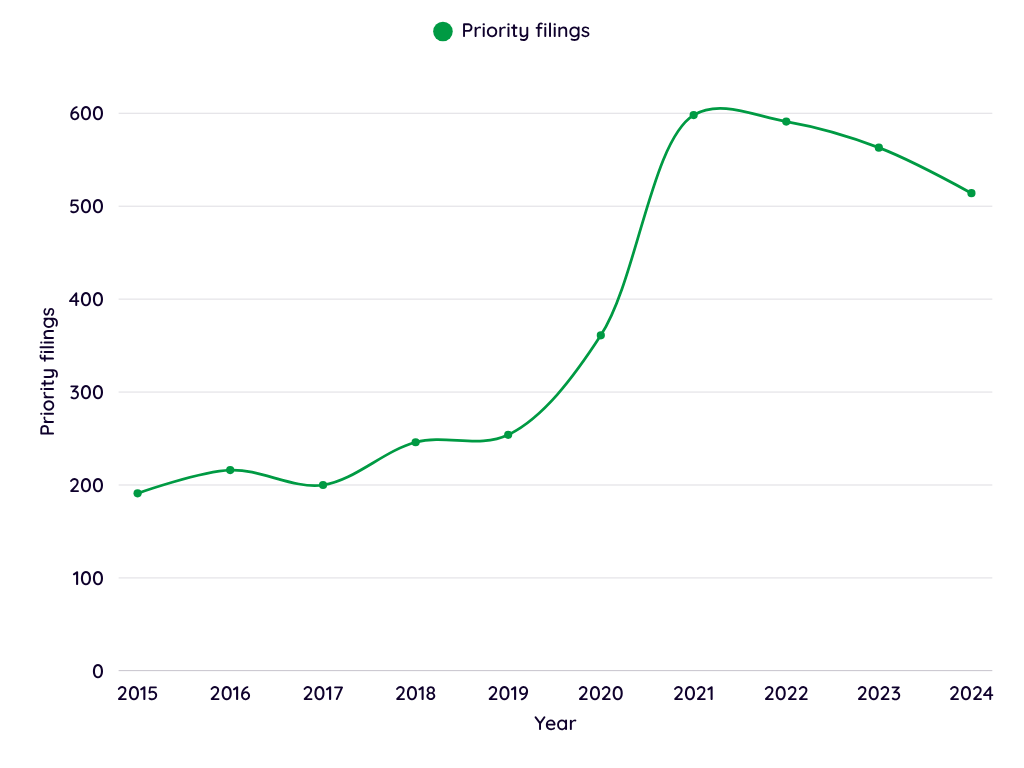
The latest figures for innovation in hydrogen storage, a key enabler for green hydrogen, reveal a continued slowing – though they remain about double the 2018 level – according to the latest patent data* reported by Appleyard Lees.
Patent filings for hydrogen storage fell about nine per cent year-on-year to 2024 (from 563 to 514) and almost 15% below the all-time peak of 598 in 2021.
These are among the findings in the sixth annual edition of the now-published Inside Green Innovation: Progress Report** from the leading intellectual property firm.
Appleyard Lees’ Partner, Chris Mason, said, “The latest data suggests that activity is becoming increasingly focused on deployment challenges such as infrastructure integration, storage management and operational efficiency, rather than solely on creating new storage vessels or materials.”
“Hydrogen projects are now being built, not just announced. That shifts the challenge from proving that hydrogen works to storing, moving and handling it safely at scale – and storage patents show where innovators are focusing.”
New mechanical engineering applications continue upward trajectory
Technology applications for mechanical engineering in hydrogen storage dominate the latest patent filing figures, increasing 36% in the year to 2024 (from 650 to 886).
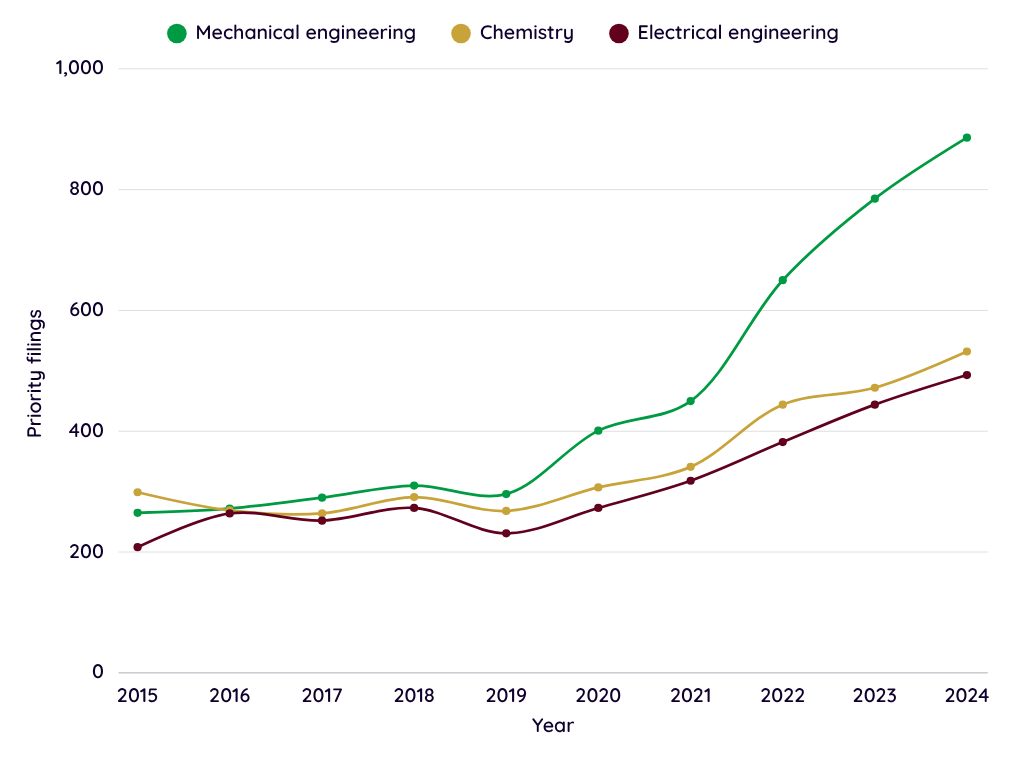
This relates to innovation in compressed hydrogen tanks, pressure vessels, system integration and thermal management.
However, patent activity increased also in chemistry (up more than 10% year-on-year from 472 to 532) and electrical engineering (up more than 10% from 444 to 493), focused on hydrogen carriers, storage materials, electrochemical systems, sensors, controls and energy management technologies.
Chris Mason added, “Innovation is gradually shifting from solving purely mechanical storage challenges towards managing hydrogen as part of increasingly complex and connected energy systems. This signals the emergence of complementary approaches addressing performance, safety and infrastructure integration challenges.”
Countries and companies
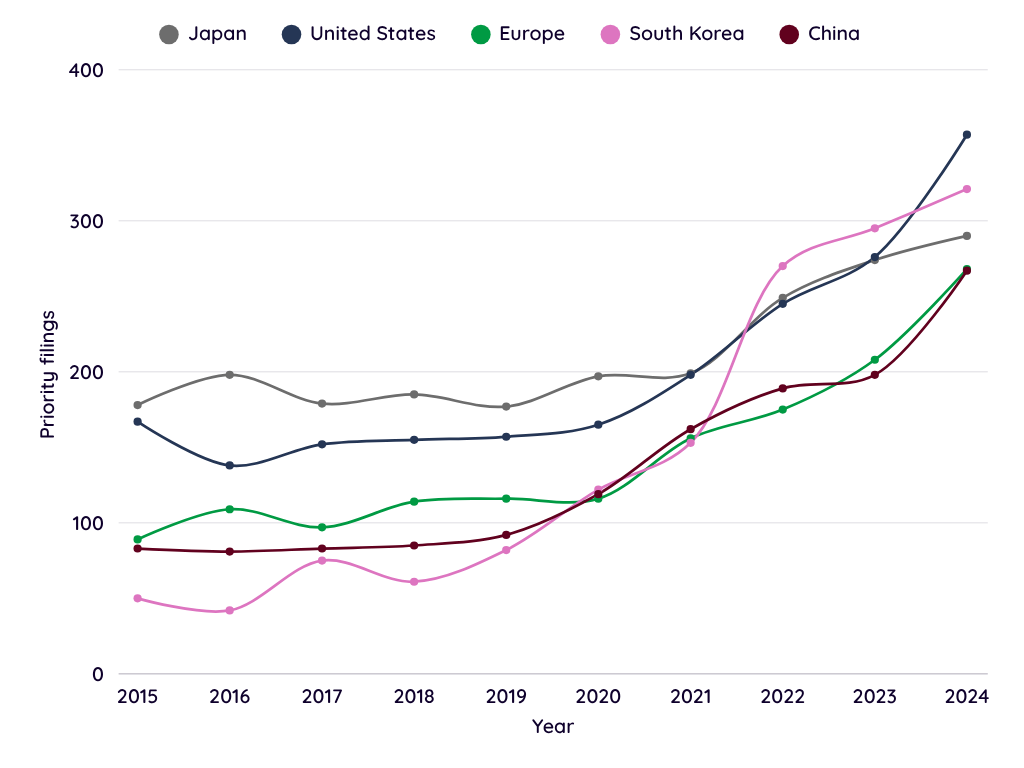
The competition among countries for first place in hydrogen innovation saw South Korea and the US swap places, with the latter outstripping its nearest rival by registering 357 patent filings versus the former’s 321 (an annual increase of almost 30% for the US). Elsewhere, innovation activity measured by patent filings increased in Europe, China and Japan.
One company continues to lead the pack in innovation growth for hydrogen: annual patent filings for Bosch increased from 26 to 30, with recent innovation concerning integrated storage architectures, diagnostics and smart tank management technologies – mirroring a broader shift across the sector towards system-level optimisation and operational management.
Meanwhile Air Liquide, working in industrial hydrogen supply, has focused its patent activity on cryogenic and underground hydrogen storage along with hydrogen recycling.
Chris Mason added, “While new patent filing growth has softened, applicants appear to be increasingly patenting what is needed to run storage in practice, such as connecting storage to hydrogen production and use, tracking the condition of tanks and detecting leaks and managing equipment over its working life.
“For businesses and innovators, this may indicate that competition is moving beyond individual storage components towards integrated solutions spanning hardware, software and operational management. Increased activity in diagnostics and monitoring technologies also highlights the growing importance of safety, reliability and asset optimisation as hydrogen infrastructure scales.”
*Inside Green Innovation: Progress Report – sixth Edition, examines patent filing data through 31 Dec 2024, the latest date complete filing data is available from public sources.
**Appleyard Lees’ Inside Green Innovation: Progress Report – Sixth Edition is available to read here.