
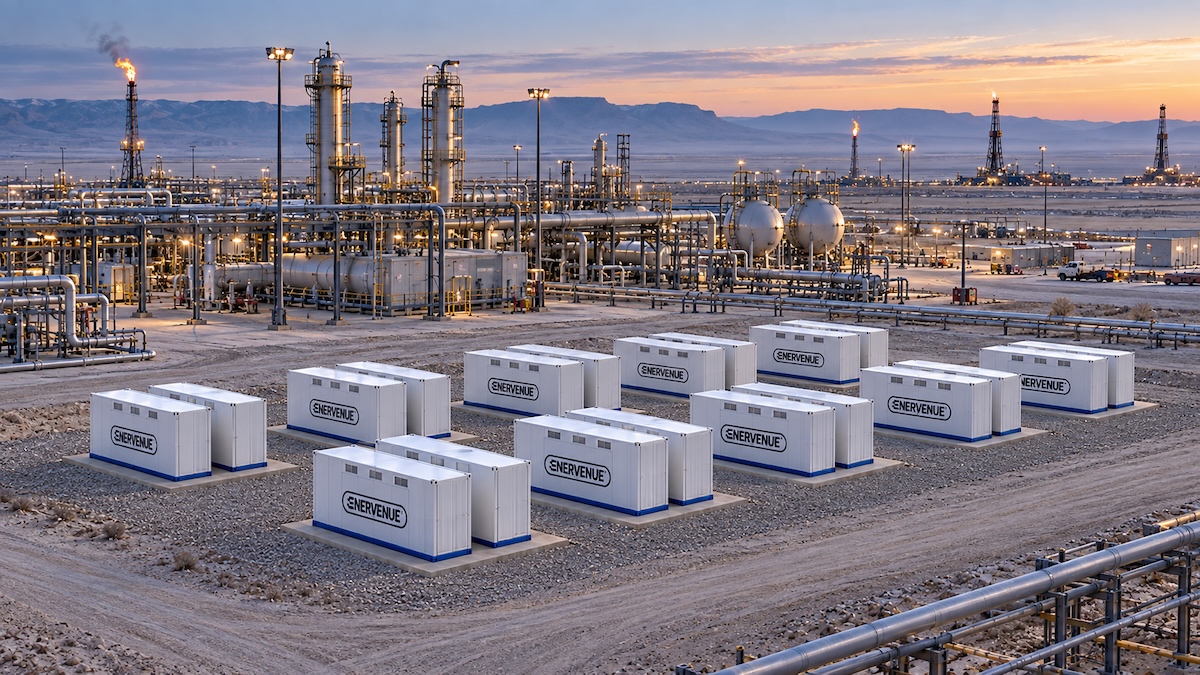
EnerVenue has signed its first multi-megawatt-hour commercial order. Twenty-six Energy Prism containerised storage units, with a combined capacity of 11 MWh, will be installed at an oilfield in northern China, where they will store electricity generated by an onsite solar array and supply it back to the operation. The first three units ship in December 2026 and the remaining twenty-three follow in March 2027.
The order was placed by a major Chinese oil and gas producer for one of its established production sites. Further details of the project, including the end user, will be shared as the installation progresses.
EnerVenue’s Aqueous Metal Cell carries zero risk of fire from thermal runaway. Its electrolyte is water based and non-flammable, it contains no lithium, and it has passed UL 9540A, the industry’s standard test for battery fire propagation, with no fire propagation at cell level.
The project pairs solar generation with battery storage on an operating oilfield, shifting daytime solar output into the hours when the site draws power. The Energy Prism units will be built from EnerVenue’s fourth-generation Aqueous Metal Cell and delivered as complete containerised systems, ready to connect to the site’s power conversion equipment.
EnerVenue’s first Aqueous Metal Cell installation, a 150kWh system integrating onsite renewable generation with electric bus charging, has been operating at Jintan in Changzhou since November 2025. The Northern China project is the company’s first commercial contract at multi-megawatt-hour scale.
The cells for the project will come from EnerVenue’s new high volume manufacturing line in Changzhou, Jiangsu, which opens on 24th September. The factory will produce 250MWh of Aqueous Metal Cells a year in its first phase, which is around 300 cells a day at full automation, with production ramping to 1GWh in 2027 and multi-gigawatt-hour scale by 2028 as capacity expands.
The Aqueous Metal Cell is a water-based metal battery built on nickel-hydrogen chemistry. The same chemistry powered the Hubble Space Telescope and the International Space Station for decades, and EnerVenue re-engineered it with low-cost materials for use on Earth. The cell is designed for 30,000 charge cycles, equivalent to up to three cycles a day for thirty years, compared with a typical lithium-ion figure of 8,000 to 10,000 cycles, and it requires no scheduled augmentation across that life. A lithium-ion installation is typically replaced or augmented every seven to ten years. Over the life of a project that changes the economics. An Aqueous Metal Cell installation needs no active cooling and, where local codes allow, no fire suppression system, so the auxiliary equipment that usually adds cost and complexity to a storage site is largely absent, and the levelised cost of the energy it stores over thirty years falls accordingly. The cell uses no lithium and no rare earths. Its bulk materials are steel, nickel, glass-fiber composite and a water-based electrolyte, and the nickel and steel can be recovered and reused at end of life.
EnerVenue has customer projects across six geographies: China, Australia, the United States, the European Union, Saudi Arabia and Canada. The Changzhou line is funded by the $300 million Series B extension announced in March 2026 and led by Full Vision Capital, and EnerVenue has raised over $700 million in total.