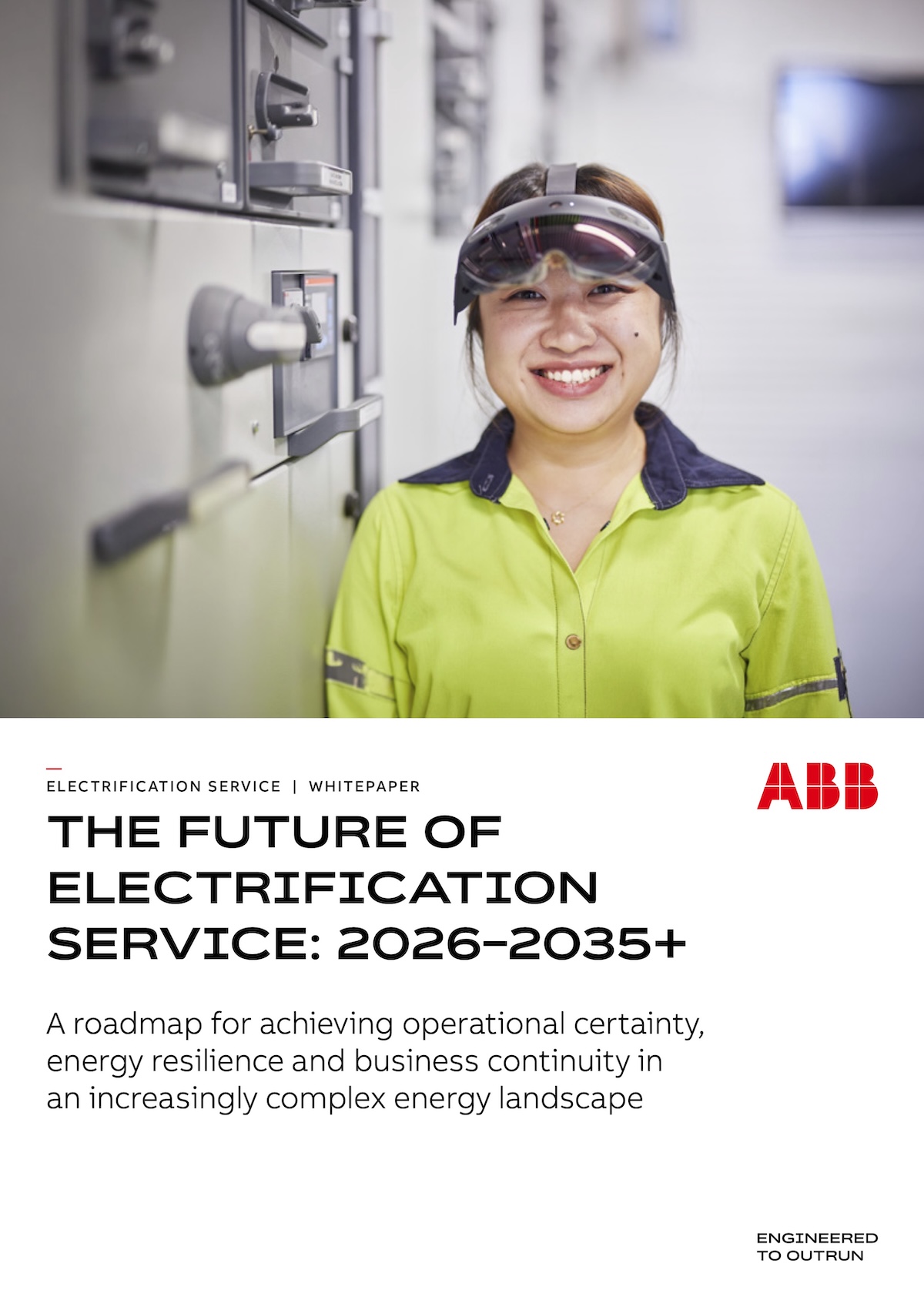
The role of electrical infrastructure needs to be fundamentally rethought due to growing energy demand, grid constraints and the cost of downtime, according to a new whitepaper from ABB.
There is huge commercial gain to be had in doing so. The Future of Electrification Service 2026-2035 report suggests that companies can gain a competitive edge if they stop thinking of electrical infrastructure as a background utility or a maintenance expense, but rather an emerging strategic asset that directly influences resilience, productivity, sustainability and growth.
The whitepaper finds that energy now makes up 25.4% of industrial operating costs, while 59% of organisations identify rising energy costs as a major threat. At the same time, unplanned downtime costs the world’s largest companies around $1.4 trillion annually, and 69% of industrial plants experience outages at least monthly.
Although most organisations recognise the need to act, they struggle to translate that into investment decisions. Critically, while 81% of senior decision-makers say total cost of ownership (TCO) should guide capital decisions, only 37% apply it in practice.
It concludes that, as power systems become increasingly intelligent, distributed and interconnected, organisations will move beyond simply consuming electricity to actively managing, storing, optimising and orchestrating it. In parallel, resilience, affordability and sustainability will cease to be separate objectives and become different outcomes of the same operational strategy.
“The boundary between energy producer and energy consumer is beginning to disappear.” said Stuart Thompson, President of Electrification Service at ABB. “For decades, organizations have treated electrical infrastructure as something they connect to and maintain. But the next decade will fundamentally change that relationship. Businesses will increasingly become active participants in the energy system, generating, storing, optimizing and orchestrating energy in real time.
“At the same time, resilience, affordability and sustainability are no longer separate objectives that can be managed independently. They are becoming different outcomes of the same strategy. The organisations that succeed will be those that can balance all three simultaneously, and they will get there much faster if they start now”.
The report goes on to outline how electrification service is expected to evolve through to 2035 and beyond, driven by AI, automation, energy storage, digital asset management and new service models. Among the key shifts identified:
- Electrical infrastructure evolving from a passive network of assets into an intelligent operating system that continuously anticipates risk, optimises performance and supports operational certainty.
- Data centers, industrial sites, battery storage systems and utilities are expected to operate as part of a far more dynamic and coordinated ecosystem, where energy is generated, stored, optimised and shared according to changing operational and grid requirements.
- Service models shifting from maintenance and equipment ownership toward outcome-based partnerships focused on uptime, resilience and performance.
To help organisations prepare for the next ten years, the report outlines five practical pathways to action today:
- Strategic asset management
- AI and digital solutions
- Energy storage
- Energy and carbon services
- Advisory services.
The full whitepaper is available here.
Explore additional insights through ABB’s Mastering Operational Certainty hub.