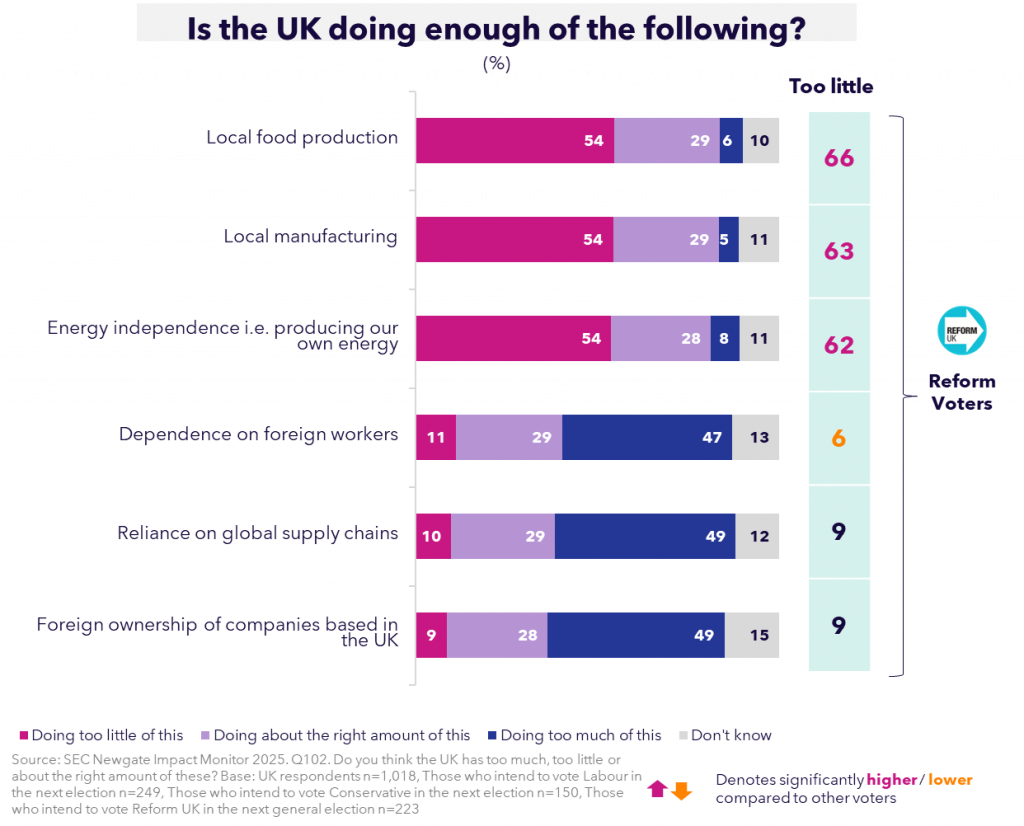
The majority of Brits believe business is doing too little to prioritise local food production, local manufacturing and energy independence and relying too heavily on overseas supply chains and foreign ownership of UK companies, according to the 2025 SEC Newgate UK Impact Monitor — part of a global annual study tracking public expectations of responsible business.
The report ‘Managing Reputational Risk and Opportunity in a Fragmented World’ is published at a time when business is navigating a period of significant economic and geopolitical change and highlights how those businesses that are seen to act responsibility will build deeper trust with their customers, partners and suppliers.
If business focused on driving operational impact, jobs and investment locally rather than globally, those surveyed said they would regard those businesses more favourably:
- Almost three-quarters (74%) say they would feel more positively about business if it manufactured products locally;
- 71% would feel more positive if business paid tax locally;
- 71% would back business sourcing raw materials and components locally;
- A further 67% say they would feel more positively about business if it based its HQ in the UK.
The study also reveals that more than two-thirds of the UK public surveyed believe the country is heading in the wrong direction and want business to act more responsibly across environmental, social and governance factors, and want to see transparency and proof of tangible impact.
High expectations, low trust: Responsible business remains a reputational dividing line
More than three-quarters (78%) of the public want business to act in the best interests of all their stakeholders (including shareholders), with 43% believing business isn’t doing enough to be open and transparent and a further 18% unsure if business is doing enough.
Despite slight improvements in perceived performance since 2024, businesses and government agencies continue to fall short of public expectations, with those surveyed calling on business and government to do more to conduct themselves responsibly:
- Less than half (48%) of large businesses operate responsibly;
- Trust in information sources is weak: media and social platforms rank among the lowest‑performing “industries” in perceived responsibility — sitting alongside mining and chemicals.
UK communities want businesses to act responsibly across environmental, social and governance factors, but they also seek proof of tangible impact, transparency, and evidence that commitments are genuine, not superficial.
UK sentiment strongly supports business action on climate — but affordability pressures remain
Climate action continues to be viewed as a key imperative for business with 69% believing the business should prioritise carbon reduction over profits and half believing that prioritising climate action over reducing prices should be a focus.
Despite political pressure on sustainability targets and cynicism about ESG the public want business to act responsibly and prioritise climate action:
- 68% say transitioning to renewable/clean energy sources is highly important;
- 66% say acting decisively on climate change is highly important;
- 63–65% feel more positive about organisations and businesses that use renewable energy and demonstrate environmental sustainability.
Yet the UK remains divided on trade‑offs. While most support prioritising carbon reduction over profitability, the public is split when climate action increases consumer prices or competes with wage growth, revealing a tension businesses must navigate carefully.
Strong support for businesses speaking out — but mixed views on DEI and social issues in practice
UK communities also continue to expect companies to communicate their values, a trend that has been reflected in pervious SEC Newgate UK Reports:
- 82% say businesses should speak out on environmental issues even if this risks government disapproval;
- 79% say they should talk openly about values;
- 76% support businesses speaking out on social issues even when there is political disagreement.
However, fewer support DEI hiring targets, preferring a “best candidate wins” approach. Support remains strong for closing the gender pay gap and accessibility initiatives but softens for broader diversity targets. Amongst the global report, the UK ranks one of the lowest on public support for DEI initiatives.
Speaking on the findings, Fiorenzo Tagliabue, Group CEO of SEC Newgate, said, “Corporate reputation has shifted markedly over the past year. As political scrutiny and social expectations evolve, our Impact Monitor shows a clear pattern across markets: people judge companies by the real impact they deliver — particularly in the communities closest to their operations. This shift is redefining how organisations earn credibility and permission to operate.”
“For global companies, the challenge is bringing differing local expectations together in a coherent global direction and, in turn, implementing that direction in ways that are meaningful in each market. Meeting this challenge requires a deep understanding of the communities, regulators, markets and media they operate among, as well as the ability to balance varied expectations while maintaining credibility worldwide.’’
On the UK findings, Emma Kane, CEO of SEC Newgate UK, said, ”Our Impact Monitor makes it clear the UK public is far from unanimous in its expectations of business impact. For some, financial stability and pragmatism are paramount; for others, authenticity, local operations, and taking a bold stance on values are non-negotiable. This expectation becomes increasingly pressing for younger generations.”
“Good corporate reputation continues to be defined by positive, tangible and authentic impact as much as it is by strong financial performance. Big picture, global commitments are often viewed with suspicion as potential agents for greenwash; the public seek proof, local action and consistency.”