
New polling published today shows that people across Wales strongly support expanding renewable energy. Public backing spans the political spectrum, including among voters often assumed to be opposed.
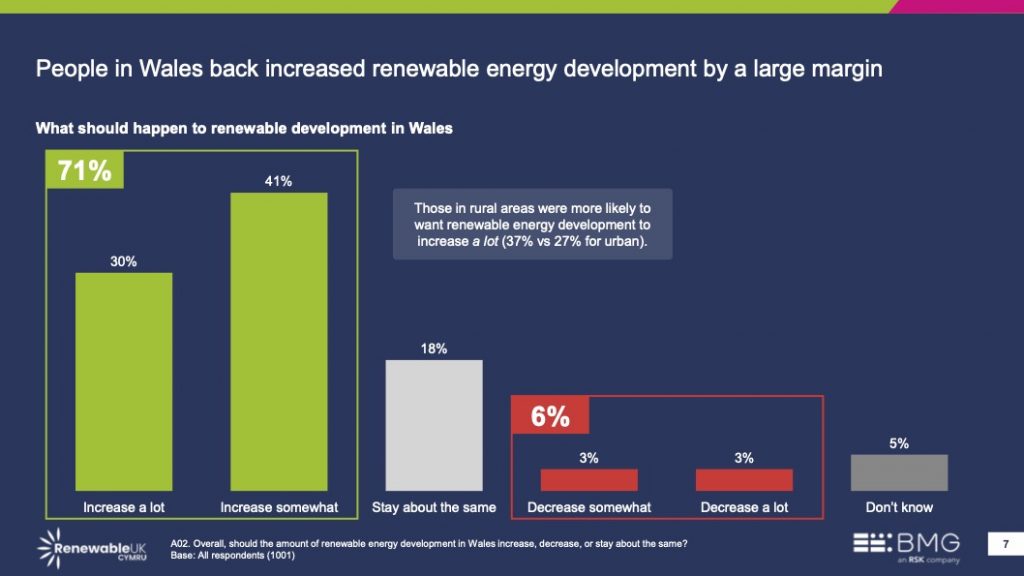
Research commissioned by RenewableUK Cymru finds that 71% of people in Wales believe renewable energy development should increase, with just 6% saying it should decrease. A clear majority of people (58%) want Wales’s future energy system to be mainly or entirely based on renewable energy.
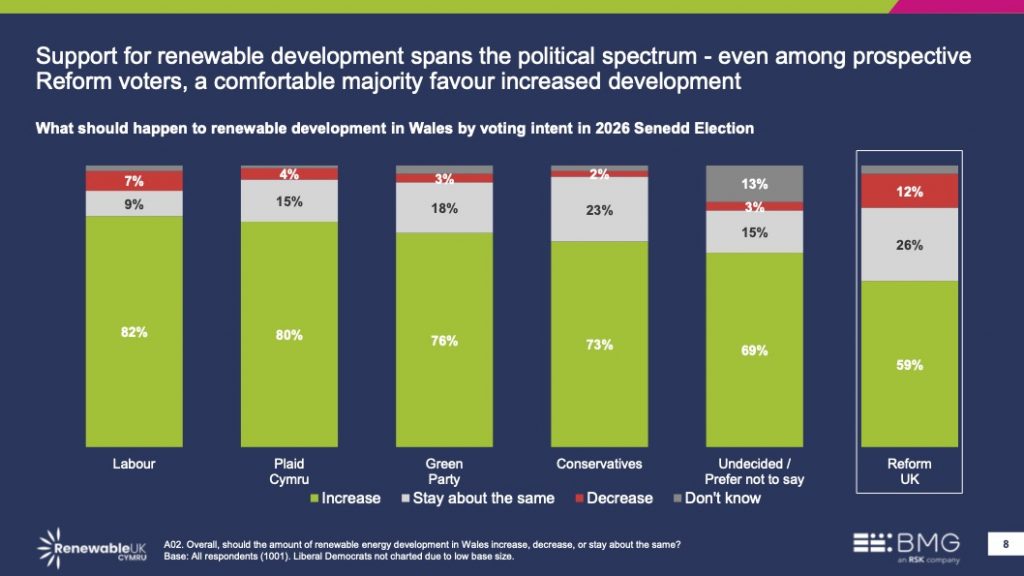
Support for renewables cuts across party lines, with strong backing among Labour, Plaid Cymru, Conservative and Green voters. Conservative voters remain highly supportive across renewable technologies, despite their party’s harder line on onshore wind and solar. Reform UK voters are more divided, but even here a clear majority (59%) favour more renewable energy development — highlighting a gap between party positioning and voter attitudes.
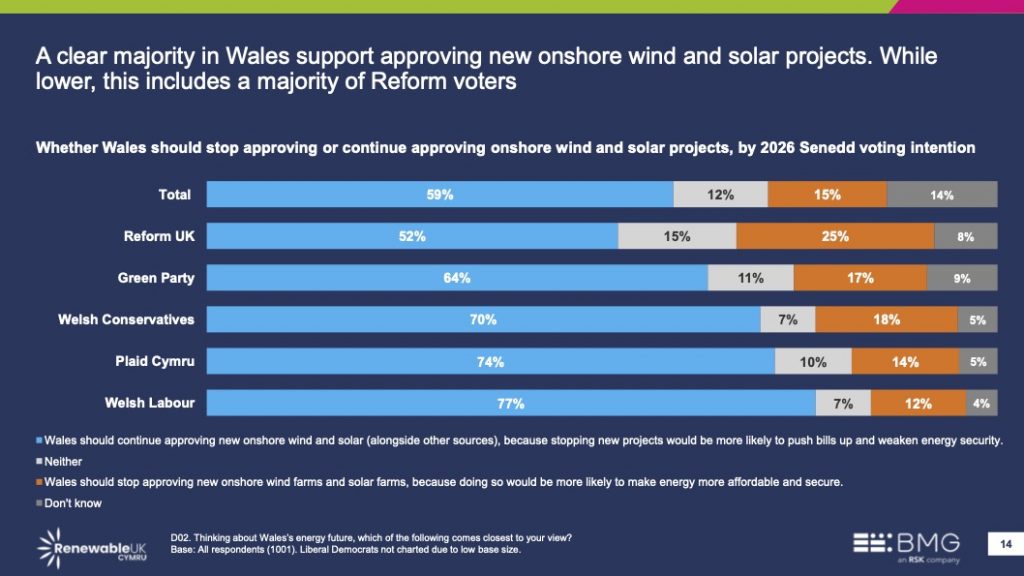
However, the polling also highlights important nuances in public opinion that challenge assumptions about opposition to renewable projects and energy infrastructure. Voters are broadly pro‑renewables and open to the trade‑offs when costs and community benefits are clear – suggesting some political debate is drifting away from where public opinion actually sits.
Voters back renewables – but reject higher bills
Public support for renewables is strong, but voters – especially Reform UK supporters – are clear that driving bills down is also a key priority. Lowering bills over time is one of the most commonly cited benefits of renewables among voters, but cost and affordability are also among their top concerns.
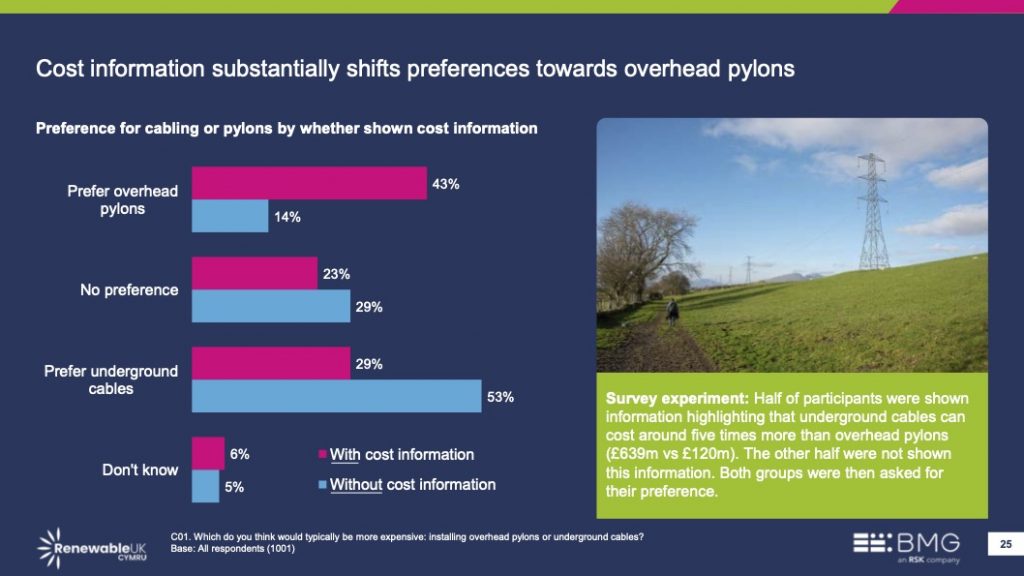
This becomes particularly clear when people are shown information on the cost of electricity grid infrastructure. Public views actively flip once costs are understood. When voters are not shown cost information, 53% prefer underground cables – but that falls to 29% once they’re told undergrounding can cost up to five times more, while support for overhead pylons rises sharply from 14% to 43%. Around two thirds of voters say they would not be willing to pay higher energy bills to fund more expensive grid options, and this trend is particularly strong among Reform UK voters.
The findings suggest public attitudes are not fixed or ideological, but pragmatic and responsive to clear information about costs and consequences.
Gap between perception and reality
The polling also reveals a striking gap between how people perceive Wales’s current performance and the reality. Around four in ten people believe Wales already generates a higher share of its electricity from renewables than the UK average, when in fact Wales is currently behind (33% of electricity generation comes from renewables in Wales, versus just over 50% for the UK as a whole). When presented with the reality in focus groups, participants expressed surprise and disappointment – indicating that many people expect Wales to be further ahead and want to see faster progress.
Community benefit: awareness gap, not ideological opposition
The research also challenges assumptions about public attitudes to community benefit funds linked to renewable energy projects.
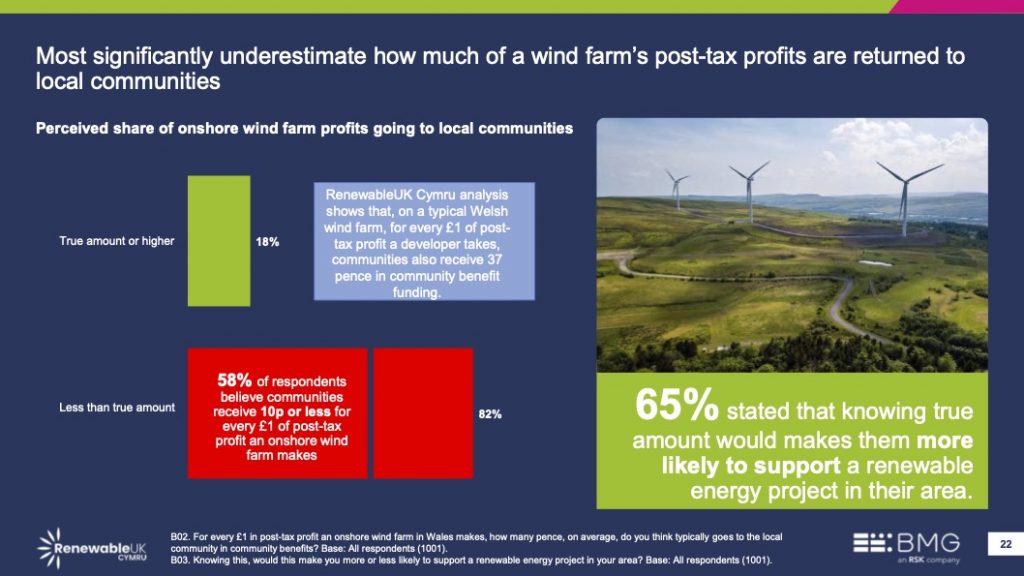
Over three quarters of people say they have little or no understanding of community benefit funding schemes. Many also significantly underestimate how much money typically flows back into local communities from the average onshore wind farm in Wales.
When told that for every £1 in post-tax profit a developer makes, 37 pence is reinvested into the local community, nearly two-thirds (65%) of people say that knowing this would make them more likely to support a renewable project in their area. The effect is strongest among Plaid Cymru voters, for whom community benefit and local reinvestment are among the most persuasive reasons to support renewable energy.
This suggests that scepticism is often driven by lack of information, rather than fixed views – and that clear, concrete explanations of how communities benefit can actively shift support, especially among voters who prioritise local value and fairness.
Jessica Hooper, Director of RenewableUK Cymru, said, “This research shows that people in Wales are firmly behind renewable energy, across political divides – but it also shows they are thoughtful and pragmatic, not blindly supportive or ideologically opposed. They want honesty about the trade-offs, clear information on costs and delivery, and confidence that communities will share in the rewards.
“The risk now is not public resistance but misreading public opinion. With electricity demand projected to double – potentially triple – by 2050, decision makers need policies that deliver clean power at pace, keep bills affordable, and be honest about the trade-offs.”