
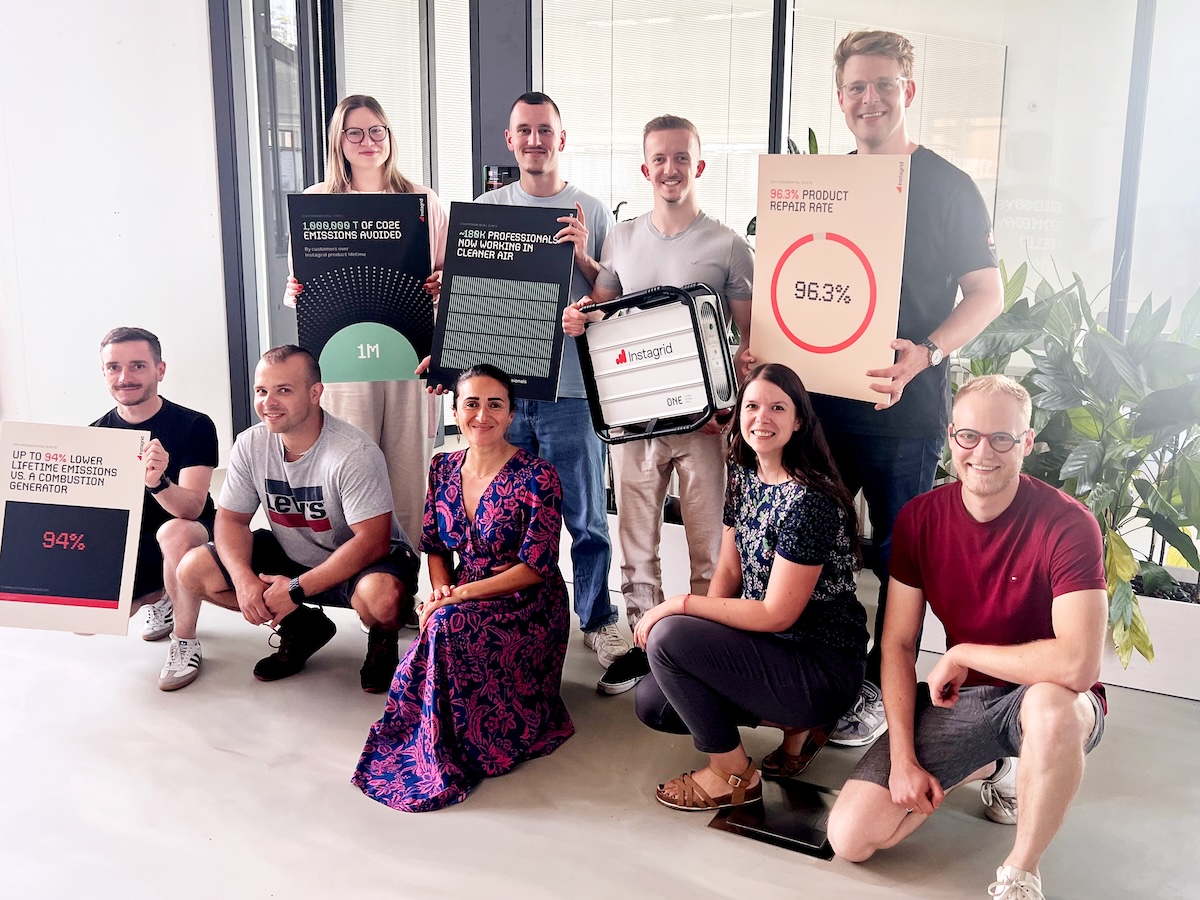
Customers of clean portable power specialist Instagrid have collectively avoided one million tonnes of potential carbon emissions by making the move to battery technology.
Diesel generators have long been the go-to choice for off-grid power in sectors including construction, events, TV and film production and utility services. However, prioritising cleaner, quieter, more cost-effective and safer solutions has led many companies to switch to portable battery power systems instead, with the rental market leading the way in reshaping off-grid energy use.
By choosing Instagrid’s advanced portable power supply solutions over combustion generators, customers worldwide have been empowered to reduce their carbon footprint and help avoid 1 million tonnes of potential CO2e emissions over the lifetime of the equipment – the same as the annual carbon saving made by 281 wind turbines.
The data, highlighted in Instagrid’s latest Impact Report, reflects a collective shift in how organisations access off-grid and rental power.
Instagrid has sold nearly 60,000 portable battery units globally over the last five-year period, demonstrating a clear move towards organisations choosing electrification to cut costs and emissions, in line with Instagrid’s own ESG commitments.
In total customers have avoided 401 tonnes of NOₓ – the equivalent of travelling to the moon and back 1,300 times – and 310,457 tonnes of localised CO emissions at the point of work – equal to removing 444,000 cars from the road. An estimated 180,000 professionals are now working in healthier, quieter conditions as a result.
Andreas Sedlmayr, Co-founder and Co-CEO of Instagrid, said, “Avoiding 1m tonnes of potential carbon emissions is climate action at scale. Achieving this sort of impact shows that our solutions have disrupted an established, but entrenched, market and this change is positive both for our customers’ well-being and the environment.”
Independently tested by TÜV NORD, Instagrid solutions produce up to 94% fewer greenhouse gases over their lifetime than a comparable combustion generator. Instagrid customers also report lower operational costs and fewer servicing requirements, as well as faster deployment.
Instagrid has now set a target of cutting a further 23 million tonnes of CO2e by 2030 in line with the Science Based Target initiative (SBTi). It also aims to reduce Scope 1 and 2 emissions by 90% against its 2022 baseline and to reduce Scope 3 emissions intensity across the full value chain by 55%.