
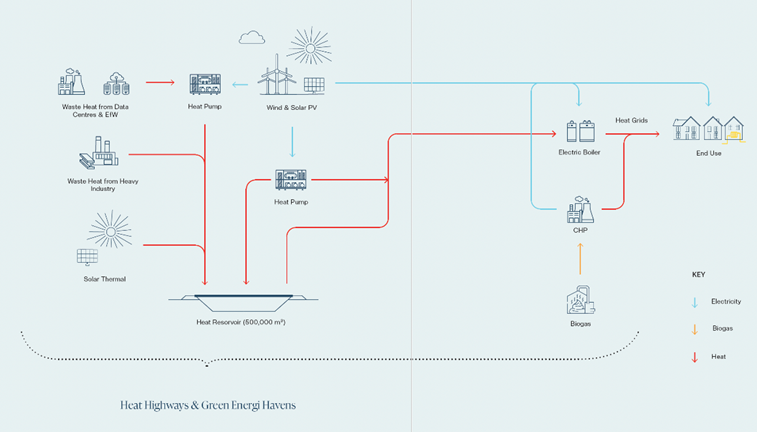
Analysis from EnergiRaven and Viegand Maagøe finds that projected growth in data centres will produce enough waste heat to warm millions of homes in the UK by 2035 – if the infrastructure is in place to take advantage of it.
The UK risks missing out on a major source of low-cost home heating if it fails to invest in the Heat Highways needed to capture waste heat from the next generation of data centres. New analysis shows that these facilities could supply enough heat for at least 3.5 million homes by 2035.
With many existing or proposed data centres situated close to planned new towns, or existing heat poverty hotspots – and in many cases, both – the research warns that without action, the UK could end up building a vast new AI infrastructure while leaving the free heat it produces to go to waste, rather than using it to reduce bills and reinforce energy resilience.
“Our national grid will be powering these data centres – it’s madness to invest in the additional power these facilities will need, and waste so much of it as unused heat, driving up costs for taxpayers and bill payers,” commented Simon Kerr, head of heat networks at EnergiRaven.
“Microsoft has said it wants its data centres to be ‘good neighbours’. Giving heat back to their communities should be an obvious first step.”
Around Manchester, for example, 15,000 homes are planned in the Victoria North development, and 14,000-20,000 in Adlington. Several areas of fuel poverty are clustered around Manchester – but so are over a dozen existing data centres, with four new facilities planned. These facilities could easily supply heat to all these new planned homes.
The research from EnergiRaven, an organisation mapping the future of heat in the UK, in partnership with the leading Danish energy and sustainability consultancy Viegand Maagøe, examines how this pattern plays out across the UK, and how data centres could provide enough waste heat for millions of homes – between 3.5-6.3 million, depending on the efficiency and other factors of data centre design.
Using waste heat to warm homes and other buildings is a common practice in northern Europe, particularly Nordic countries, where sources of waste heat – such as data centres, as well as power plants, incinerators and sewage plants – are required to connect to heat networks that store heat as hot water, and supply it directly to homes via heat interface units (HIUs), replacing gas boilers.
In the UK, many cities have already been designated as ‘Heat Network Zones’ where heat networks have been already identified as the cheapest low carbon heating source, aiming to accelerate the development of such networks. In 2026, Ofgem will take over regulation of heat networks, and new technical standards will be introduced for the technology via the Heat Network Technical Assurance Scheme (HNTAS), aiming at boosting consumer and investor confidence.
The recent Warm Homes Plan also sets a target of doubling the proportion of heat demand met by heat networks in England to 7% (27TWh) by 2035, with heat networks expected to supply around a fifth of all heat by 2050. It also pledges £195m per year via the Green Heat Network Fund to support heat network development. However, Kerr argues that these steps do not go far enough towards taking full advantage of waste heat.
“Current policy in the UK is nudging us towards a patchwork of small networks that might connect heat from a single source to a single housing development. If we continue down this road, we will end up with cherry-picking and small, private monopolies – rather than national infrastructure that can take advantage of the full scale of waste heat sources around the country.”
“We know that investment in heat networks and thermal infrastructure consistently drives bills down over time and delivers reliable carbon savings, but these projects require long-term finance. Government-backed low-interest loans, pension fund investment, and institutions such as GB Energy all have a role to play in bridging this gap, as does proactivity from local governments, who can take vital first steps by joining forces to map out potential networks and start laying the groundwork with feasibility studies.”
Peter Maagøe Petersen, director and partner at Viegand Maagøe added, “We should see waste heat as a national opportunity. In addition to heating homes, heat highways can also reduce strain on the electricity grid and act as a large thermal battery, allowing renewables to keep operating even when usage is low, and reducing reliance on imported fossil fuels. As this data shows, the UK has all the pieces it needs to start taking advantage of waste heat – it just needs to join them together.”
“With denser cities than its Nordic neighbours, and a wealth of waste heat on the horizon, the UK is a fantastic place for heat networks. It needs to start focusing on heat as much as it does electricity – not just for lower bills, but for future jobs and energy security.”