Geotab, a global leader in connected vehicle and asset management solutions, today revealed that more than 1.58 million litres of fuel were burned while Geotab-connected vehicles sat stationary in traffic across Europe’s major capitals during 2025. Across the vehicles analysed, idle fuel waste reached an estimated €2.6 million over twelve months.
The findings form part of Geotab’s European Urban Freight Efficiency Index, which analysed a full year of connected vehicle data across seven major capitals: London, Berlin, Amsterdam, Dublin, Rome, Paris and Madrid.
The €2.6 million figure reflects 2025’s average European fuel prices. European diesel has risen above €2 per litre in the first half of 2026, a 30% increase triggered by geopolitical instability in the Middle East. These fuel prices would bring the cost of the same volume of idle waste to approximately €3.6 million.
London: Europe’s unpredictable stop-start capital
Across the seven cities in the study, the relationship between congestion and fuel efficiency diverges sharply depending on how traffic moves, not just how much of it there is. The most congested city is not necessarily the one costing fleets the most in fuel.
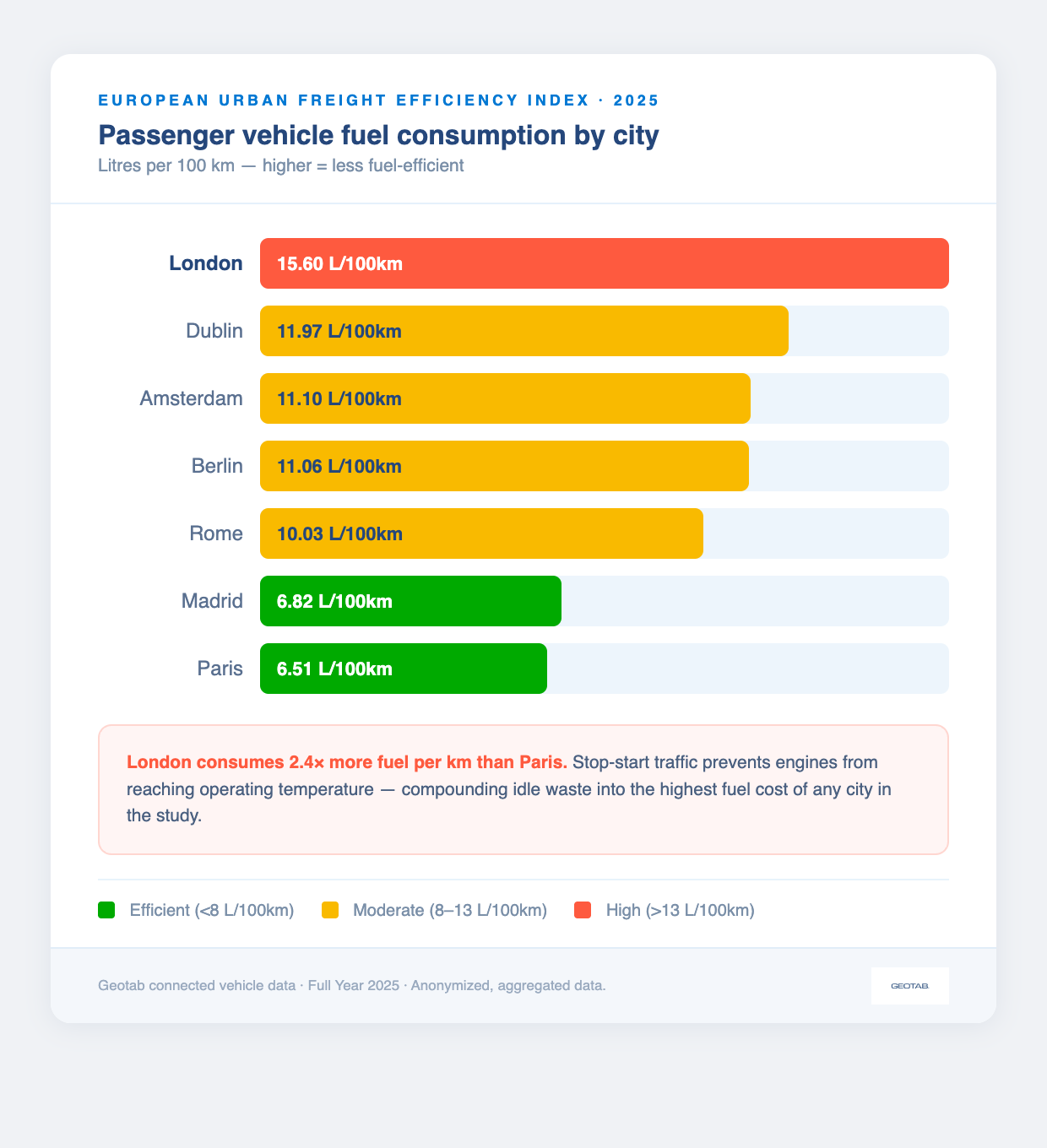
London represents one of the most challenging operating environments for fuel efficiency among the seven cities. Ranked sixth (out of seven) in the Index, its stop-start traffic patterns prevent engines from reaching operating temperature, while its unpredictability compounds the problem. London recorded the highest passenger vehicle fuel consumption of any city analysed, at 15.60 litres per 100 kilometres, almost two-and-a-half times higher than Paris.
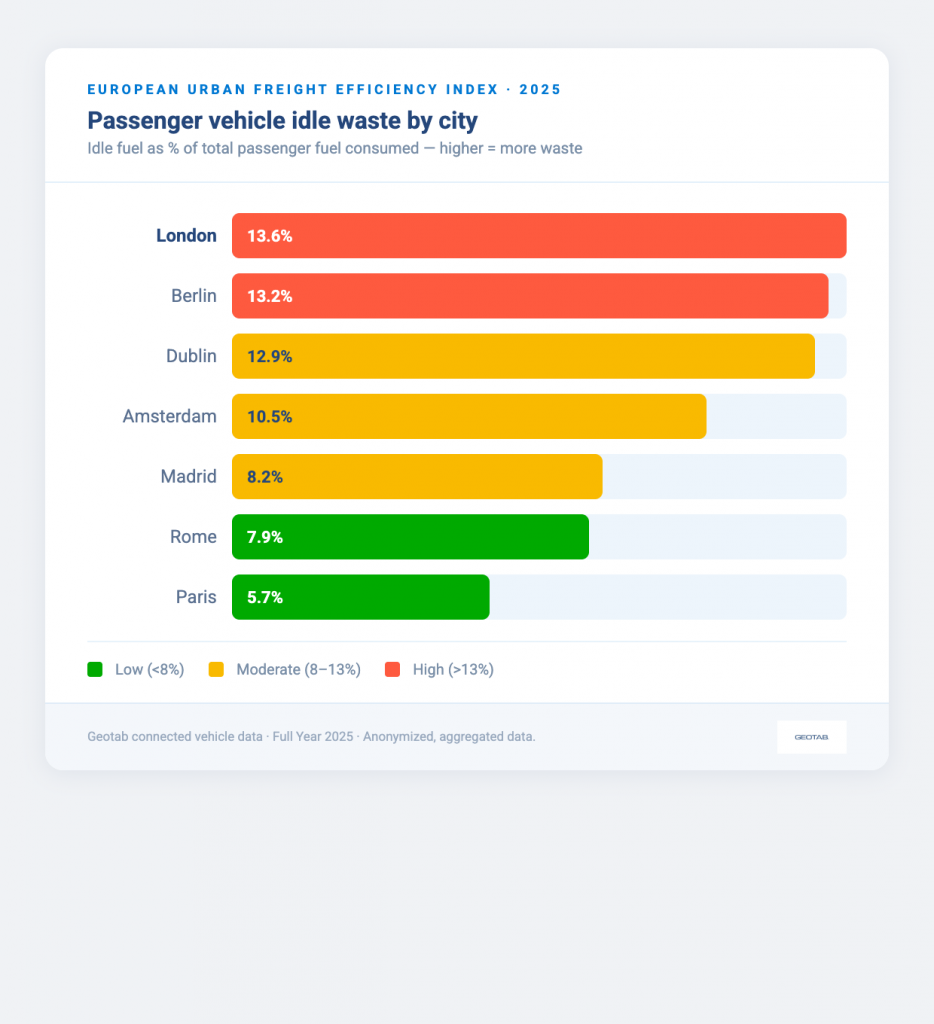
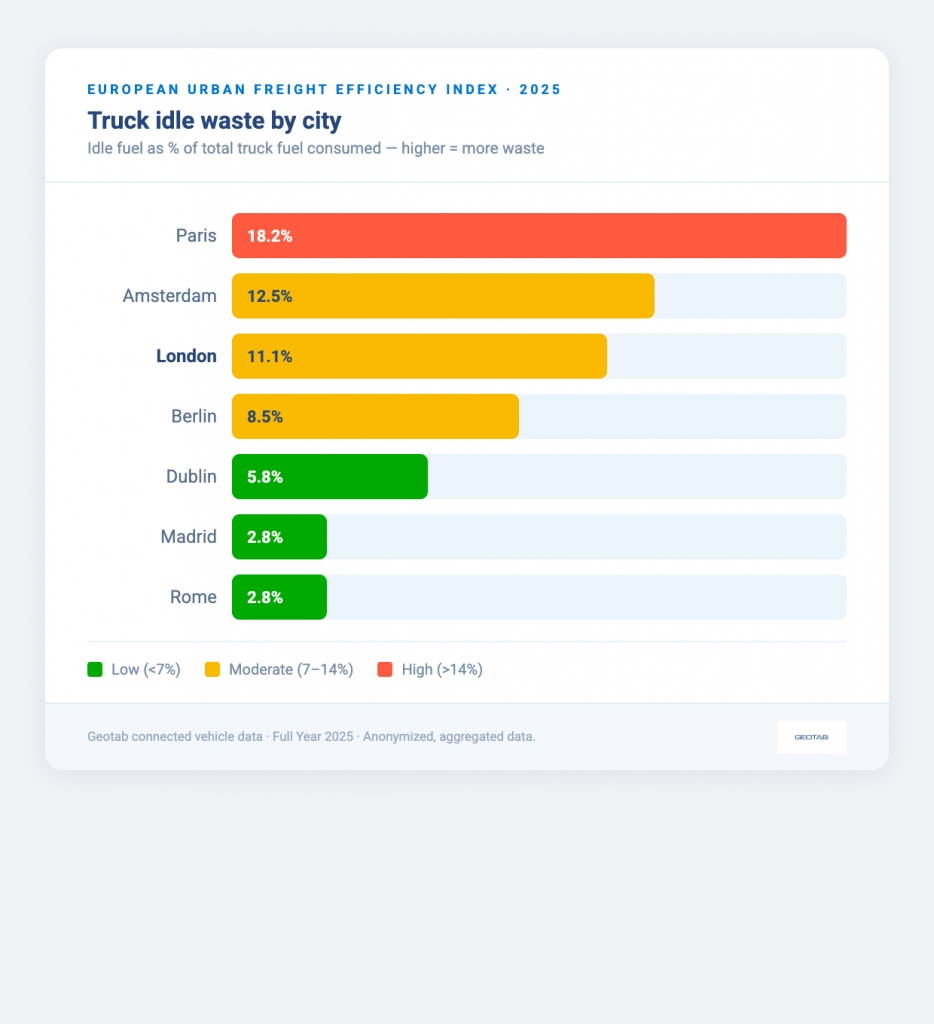
Of every litre of fuel burned in London by passenger vehicles, 13.6% is consumed while stationary. Commercial trucks idle at 11.1% of total fuel consumed. Lower than the passenger rate, but still among the higher truck figures across the study, reflecting the loading restrictions, bus lane exclusions and concentrated delivery windows that make London uniquely challenging for commercial vehicle operations.
The findings also show that slow traffic and wasteful traffic are not always the same thing. Berlin leads the overall Index and records lower truck idle waste than London, at 8.5% compared with 11.1%, while Amsterdam ranks second and keeps passenger vehicle idle waste to 10.5%, below London’s 13.6%. Dublin sits third overall but shows a similar passenger vehicle idling issue to London, with 12.9% of fuel consumed while stationary, although its trucks perform better at 5.8%. Rome and Madrid are the clearest counterpoints: both record just 2.8% truck idle waste, the lowest in the study, because traffic may be slow but continues to move. Paris shows the reverse pattern, with predictable journey times but the highest truck idle waste rate in the study, as commercial vehicles lose almost one in every five litres of fuel while stationary.
Edward Kulperger, Senior Vice President, EMEA at Geotab, said, “Congestion has traditionally been measured through the lens of time. How long journeys take, how busy roads become and how delays affect operations. What this analysis shows is that there is another layer of cost sitting beneath that discussion.
“When vehicles are idling, fleets are effectively burning money. Our data shows it costs them millions: fuel consumed with engines running and wheels going nowhere. Every litre of that is also an emissions cost. Beyond the time lost, the burden of congestion is financial and environmental. The fleets navigating it best are those with the clearest picture of where those costs are falling.”
Read the full report here.