
Chris Hyde, Business Line Manager – Air and Gas Applications, Atlas Copco UK
The UK hydrogen market has reached an inflection point. Enquiries are real, projects have secured HAR (Hydrogen Allocation Rounds) funding, and electrolysers are being installed. Yet scale remains elusive. For every one scheme progressing towards commissioning, another stalls.
The bottleneck is no longer technical feasibility. It is the commercial framework that sits around hydrogen production that is missing. Developers can build capacity, but they also need confirmed buyers. In practical terms, that means long-term offtake agreements under which industrial users commit to purchasing defined volumes of hydrogen at agreed prices. Without that guaranteed demand, projects struggle to secure financing and reach final investment decision. Investors require confidence that the hydrogen produced will be sold consistently at a price that makes the project financially viable over its lifetime.
Hydrogen has moved beyond the pilot phase. The question now is whether the UK can convert early momentum into durable, revenue-backed production.
Policy ambition versus project delivery
The UK’s commitment to net zero by 2050 places hydrogen firmly within national decarbonisation plans. The Hydrogen Allocation Rounds, HAR1 and HAR2, were introduced to stimulate early production capacity and de-risk initial investment. They represent an important signal of political intent.
However, funding announcements are only one part of the equation. Projects must navigate planning approvals, grid constraints, infrastructure readiness and supply chain availability before they reach full operation. As with many major energy infrastructure initiatives, timelines often extend beyond original expectations.
Hydrogen projects also introduce engineering considerations that are unfamiliar to many industrial operators. Moving from concept to operation requires high-pressure gas handling, integrated control systems and safe storage solutions that must perform continuously in demanding environments. The supporting infrastructure is as critical as the electrolyser itself.
Producers and offtakers: a structural imbalance
One of the most significant barriers to scale lies in the relationship between hydrogen producers and offtakers,the industrial users or energy suppliers that commit to buying the hydrogen produced.
On the production side, developers can secure support mechanisms to build electrolysers and associated compression and storage systems. On the demand side, however, long-term, bankable purchase agreements remain harder to secure. Without stable offtake contracts, projects struggle to reach financial closure.
Cost remains central to this imbalance, and it is important to distinguish between different types of hydrogen. Grey hydrogen, currently the dominant form globally, is produced from natural gas through steam methane reforming and results in substantial carbon dioxide emissions. Green hydrogen, produced using renewable electricity to power electrolysis, generates no direct carbon emissions at the point of production and aligns with net zero ambitions.
From an environmental standpoint, green hydrogen is clearly preferable. Economically, however, it remains significantly more expensive. In many cases, green hydrogen can cost five times more than grey hydrogen. That differential is narrowing, but it still influences procurement decisions for industrial users operating in competitive markets.
Until policy frameworks address incentives on both sides of the equation, supporting not only production but also demand, hydrogen deployment will continue to move in phases rather than at the pace demanded by national targets.
LCOH, efficiency and system design
As the market matures, discussions are shifting from headline funding figures to Levelised Cost of Hydrogen, or LCOH. Investors and energy managers are looking beyond capital expenditure to lifetime cost and system efficiency.
Reducing LCOH requires optimisation across the entire value chain. Renewable electricity pricing, electrolyser efficiency, system uptime, compression strategy, storage configuration and transport logistics all play a role.
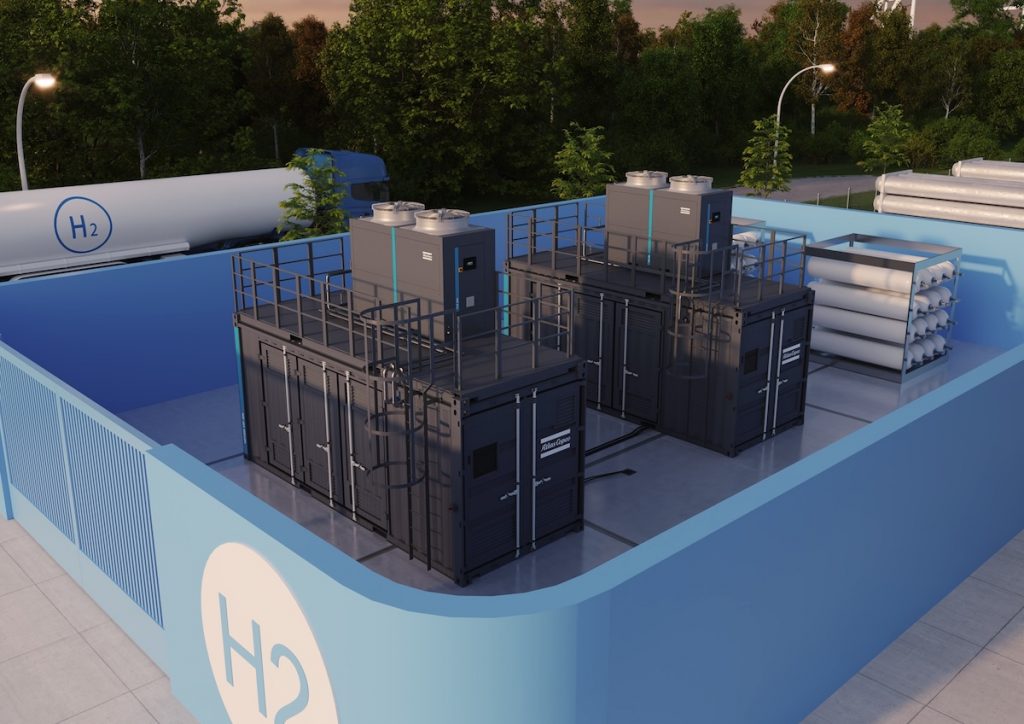
Compression is often underestimated in early modelling. Hydrogen leaving an electrolyser may need to be raised from 20 or 30 bar to 300, 500 or even 900 bar, depending on whether it is destined for storage, trailer filling, pipeline injection or mobility applications. That process must be oil free, tightly controlled and capable of handling variable inlet conditions without unnecessary energy loss.
Design choices at this stage have a direct impact on operating cost. Variable inlet pressure systems, modular containerised compression packages and predictive maintenance strategies can all contribute to improved reliability and reduced downtime. Minimising blow-off losses, where hydrogen is intentionally vented during start-up, shutdown or pressure transitions, is equally important. At higher pressures, even relatively small volumes of released gas represent lost product and wasted energy. Ensuring stable performance across fluctuating production rates becomes critical when margins are tight and every kilogram of hydrogen carries a meaningful cost.
In this context, mature gas compression technologies with long operational track records offer reassurance to project developers and EPC contractors alike.
Energy security and infrastructure
Hydrogen’s strategic value extends beyond carbon reduction. Recent geopolitical events have refocused attention on energy security and resilience. Diversifying energy sources and reducing exposure to volatile fossil fuel markets is now a central concern for policymakers and industrial operators alike.
In Europe, long-term infrastructure planning reflects this shift. Proposals such as a European hydrogen backbone aim to create cross-border pipeline networks linking production hubs with industrial demand centres. The UK’s future role within that network will depend on regulatory alignment and investment decisions, but the direction of travel is clear. Hydrogen is being treated as core infrastructure rather than a niche technology.
Large-scale pipeline and storage projects introduce further engineering demands. Higher flow rates, robust sealing systems, oil free operation and consistent pressure control become essential to safe and efficient operation. Equipment designed for modular expansion and integration into broader plant systems is likely to be favoured as projects scale.
EPCs and the transition economy
Engineering, procurement and construction contractors (EPCs) are adapting rapidly to this new landscape. Many are pivoting from conventional fossil fuel projects towards portfolios centred on energy transition technologies, including hydrogen, ammonia conversion and carbon capture.
For EPCs, risk management remains paramount. First-of-a-kind hydrogen projects require partners that understand not only the theory of decarbonisation but the practical realities of high-pressure gas handling, system redundancy and lifecycle performance.
Hydrogen compression may be central to mobility, ammonia cracking: where imported ammonia is broken back down into hydrogen for use as a fuel, or industrial fuel switching, but the underlying engineering disciplines are not new. Oil free piston compressors, hydraulic boosters and integrated monitoring systems have been deployed in demanding gas applications for decades. In hydrogen projects, the priority is selecting technologies already engineered for high-pressure, oil free hydrogen service, and deploying them within systems designed to maintain safety, efficiency and uptime from day one.
The hydrogen landscape in five years
What might the UK hydrogen sector look like by 2030?
It is unlikely to involve universal adoption across all industries. More realistically, the UK will see clusters of commercially stable projects with secured offtake agreements, clearer regulatory alignment and improving cost competitiveness. Mobility, specialist industrial processes and sectors under acute decarbonisation pressure are likely to continue leading adoption.
Hydrogen’s future in the UK will not be determined by policy ambition alone. It will depend on whether production and demand can be aligned through credible offtake, competitive cost structures and infrastructure that performs reliably under industrial conditions. As renewable generation expands and economies of scale improve, the cost gap between grey and green hydrogen should narrow. But commercial confidence will hinge on predictable performance as much as price.
The transition from pilots to production is already underway. The decisive phase will be defined by bankable projects, robust system integration and deployment of technologies engineered specifically for high-pressure, oil free hydrogen service. If those elements come together, hydrogen can move from early promise to durable part of the UK energy mix.