
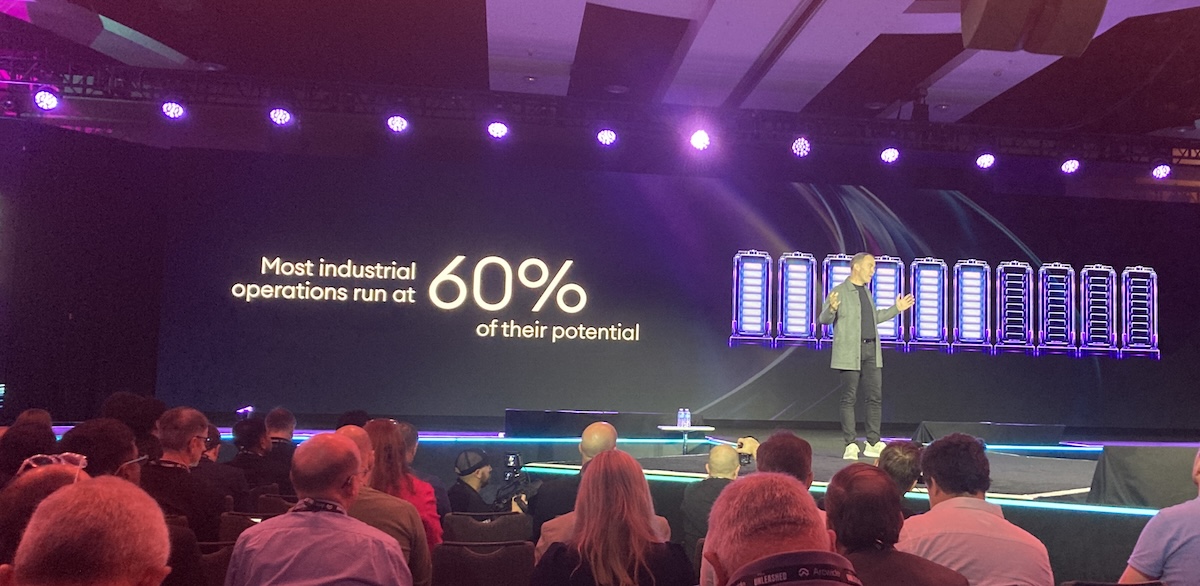
 Industrial businesses could unlock significant additional capacity from their existing assets, people and operational data by embracing industrial AI, according to IFS chief executive Mark Moffat.
Speaking at IFS Unleashed in Orlando, Moffat said industries including energy, utilities, manufacturing, aviation and infrastructure are entering a period of significant opportunity – but against a backdrop of rising demand, constrained resources and growing pressure on industrial operations.
Energy is one of the clearest examples.
Moffat pointed to rapidly increasing electricity demand and the pressure this is placing not only on energy and utility companies, but across industry more broadly. At the same time, shortages of critical equipment are creating additional constraints, with long lead times for equipment including gas turbines and diesel generators.
The challenge, he argued, is therefore not simply building more capacity. Businesses also need to get significantly more from the assets, people and infrastructure they already have.
IFS research and its work with customers suggests industrial operations can sometimes be running at only around 60% of their potential.
That leaves what Moffat characterised as a missing “40%” of capacity and productivity waiting to be unlocked.
“Where is your 40%?” he asked delegates.
The answer will differ between organisations. It could lie in inefficient processes, ageing infrastructure, shortages of skilled workers or operational information that businesses already possess but are unable to use effectively.
For energy and utilities, the latter two areas could prove particularly significant.
Turning operational data into intelligence
Industrial businesses generate huge volumes of operational data, from asset performance and maintenance records to work orders, fault codes and historical repairs.
Yet much of that accumulated knowledge remains difficult to access or use in day-to-day decision making.
Moffat argued that applying AI to this operational data could allow companies to identify patterns and make better use of years – and sometimes decades – of accumulated asset knowledge.
Rather than applying general-purpose AI to industrial businesses, the opportunity is to combine AI with detailed knowledge of assets, workflows and operating environments.
That distinction matters in sectors such as energy, where an incorrect answer can have consequences far beyond an inefficient office process.
For IFS, Moffat said industrial AI therefore has to understand the realities of frontline operations and operate within defined controls.
“A wrong answer is not an inconvenience,” he said, pointing to the potential consequences of mistakes across safety-critical industries, from grounded aircraft and stopped production lines through to risks to human life.
Giving frontline workers ‘superpowers’
The other major opportunity lies with people.
Skills shortages are already affecting many industrial sectors, while experienced workers are retiring and taking decades of accumulated knowledge with them.
Moffat argued that AI can help capture that expertise and place it directly into the hands of less experienced frontline employees.
The objective is not simply to automate jobs, but to make existing workers more productive.
He cited the example of frontline technicians, where significant amounts of working time can be lost waiting, searching for information or completing administrative processes rather than carrying out productive work.
Even relatively small efficiencies can become significant when multiplied across large field workforces.
Moffat referenced a discussion with an electricity company in Tampa where relatively straightforward applications of AI could potentially save a linesperson around 15 minutes several times during a working day.
Across a utility workforce, those incremental gains quickly add up.
AI could also allow organisations to capture the knowledge of their most experienced technicians and make it available to employees from their first day on the job.
For sectors facing significant skills shortages, that ability to scale expertise could become as important as the technology’s ability to automate individual tasks.
From AI hype to industrial application
Moffat’s central message was that the next phase of AI will increasingly be about moving beyond general-purpose applications and embedding intelligence into physical industrial operations.
For asset-intensive organisations, that means connecting AI with real operational data, physical assets, maintenance activity and the people working on the frontline.
IFS is positioning itself firmly around that industrial opportunity, arguing that AI needs to be deployed within environments where organisations can see, control and manage the actions it takes.
Moffat also stressed that no single technology company will deliver that transformation alone, pointing to an ecosystem approach involving hyperscalers, technology specialists and industrial businesses.
IFS has been expanding those relationships, including its partnership with Siemens, bringing together engineering and design data with operational, maintenance and service information.
For energy businesses facing rising demand, infrastructure constraints and continuing shortages of skilled people, however, Moffat’s broader challenge was straightforward.
Before looking only towards new infrastructure and additional resources, industrial organisations should also ask how much unused capacity is already sitting within their existing operations – and whether AI can finally help them unlock it.