
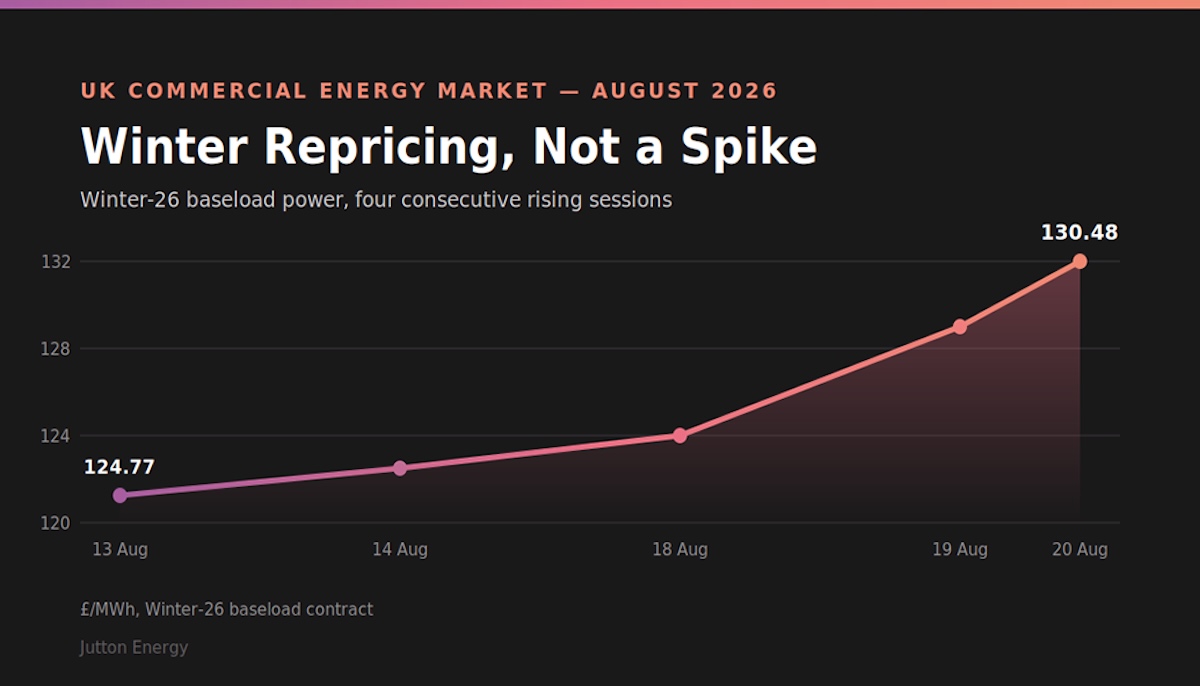
For business energy buyers, the past few weeks have delivered a clearer signal that markets often provide. This is a winter repricing, not a temporary spike. Understanding the distinction matters for anyone weighing procurement timing over the coming months.
Wholesale prices are pricing winter, not today
Winter-26 baseload power has risen on four consecutive trading sessions through mid-to-late August, climbing from £124.77/MWh on 13 August to £130.48/MWh. What’s notable is the shape of the move. Gas and power contracts across multiple delivery periods have shifted by near-identical amounts on the same days. A pattern that reflects the curve being repriced as a whole, rather than isolated news events moving individual contracts.
The near-term, physical market has told a more complicated story. UK gas system fundamentals have been comfortable through this period, Norwegian flows recovering, line pack rising, the system opening long on several mornings, yet prices have continued to firm regardless. When a market reprices upward on a day of comfortable physical supply, that is a market pricing forward risk, not reacting to a current shortage.
The balancing market has moved to the same direction. The daily minimum System Sell Price has risen for seven consecutive sessions from £70.40/MWh on 13 August to £112.00/MWh on 19 August. A substantial tightening in the cost of short-term system balancing that will filter through to any business exposed to imbalance charges or half-hourly settlement.
What’s driving it
Brent crude posted four consecutive daily rises through to 20 August, reaching its highest close of the current run, as markets priced in expectations of a US Treasury sanctions package against Iran. When the sanctions were confirmed later in the month, Brent fell back over 3%, as the measures proved less severe than markets had feared. The reversal doesn’t change the underlying picture: the geopolitical risk premium remains unresolved, and gas storage across Europe stays below typical levels for this point in the season.
A Notable policy shift
Away from short-term pricing, the more structurally significant development this month is a shift in the government’s position on domestic energy production. Prime Minister Andy Burnham has signposted a route to greater North Sea oil and gas production while maintaining that the UK’s net-zero commitments remain unchanged. Environmental groups have criticised the move as unlikely to meaningfully affect bills in the short term, a fair assessment given the scale of change involved. But the potential revenue and energy security implications are worth watching over a longer horizon.
Separately, DESNZ has approved the Beacon Fen Energy Park, a 400MW solar farm paired with up to 600MW of battery storage in Lincolnshire. Consent removes a planning barrier to capacity expansion in the East of England, and the project’s commissioning timetable is worth monitoring, since it may ease scarcity-driven volatility in the market from mid-2027 onward.
Carbon: The one exception
Amid broadly upward pressure across gas, power and oil, carbon has moved the other way. UK ETS carbon allowances have traded at a discount of over £11 a tonne to their EU equivalent, a gap worth factoring into cost projections for any business with carbon-intensive operations weighing UK versus EU-linked exposure.
What this means for procurement strategy
Three things are worth taking from the current market state:
- This is a forward curve repricing.
Businesses relying on the physical market’s relative day-to-day calm as a signal of stability should note that the forward curve is moving independently of current physical conditions. A sign that the market expects tightness to persist into winter regardless of short-term supply comfort.
- Balancing costs are a live, rising exposure.
Seven consecutive sessions of higher System Sell Price is a meaningful trend for any business on flexible or half-hourly settled contracts, not just those on fixed-volume deals.
- Policy signals are long-horizon, not immediate relief.
Both the North Sea production shift and the Beacon Fen approval are genuine developments, but neither will affect pricing this winter. They’re worth tracking for medium-term strategy, not treating as near-term cost relief.
Jutton Energy | Questions? support@juttonenergy.com