Energy Procurement is going through a seismic shift in how we pay for network transmission costs. We are moving away from the pay for what you use model to a pay for what you are allocated model. So, under the current targeted charging regimes, what you pay is increasingly dictated by how much capacity you reserve, not just what you consume, explains Jutton Energy’s CEO Ben Dhesi.
This change is the direct result of Ofgem’s Targeted Charging Review (TCR), specifically the implementation of the DCP 361 network reform.
Here is the harsh reality: a staggering number of UK businesses are paying for a vast amount of ‘ghost capacity’, headroom they haven’t touched in a decade, yet will now be billed proportionately more for these charges. If you leave this unmanaged heading into your next procurement cycle, you are looking at an unnecessary 20% to 35% premium on your network standing charges.
But through data analysis and prompt actions, or by utilising modern technology like battery storage, you can mitigate the energy costs significantly.
Understanding the banding trap: The TNUoS and DUoS reality
As Network Operators charge you based on a system of capacity bands, these costs have risen dramatically from April 2026 and are expected to continue to rise over the coming years. If your registered Authorised Supply Capacity places you at the bottom of a high band, but your actual peak demand never even scratches that ceiling, you are throwing money away.
Downgrading your banding sounds straightforward, but it requires deep technical management and precise timing:
- Forensic Data Analysis: You cannot simply guess. You need to map your half-hourly (HH) data over at least the last 12 to 24 months to identify your absolute maximum peak load.
- Early Network Application: Lowering your capacity requires a formal application to your Distribution Network Operator (DNO). This is not an overnight process. It requires an application process backed by data and compliance with schedule 32. If you don’t secure the DNO’s agreement before your next procurement contract goes live, your new supplier or broker might lock you into the old, inflated band for the duration of that term.
The strategy is clear: analyse your data early, prove your actual maximum demand to the network, drop a band(s), and lock in significant savings on your next contract.
Can’t drop your capacity that easily? Enter the behind-the-meter battery
What happens if your operational profile means you do hit a high peak, but only for an hour or two a day or week? The DNO won’t let you downgrade your ASC because they must be ready for that peak.
This is exactly where the business case for commercial battery storage becomes incredibly lucrative.
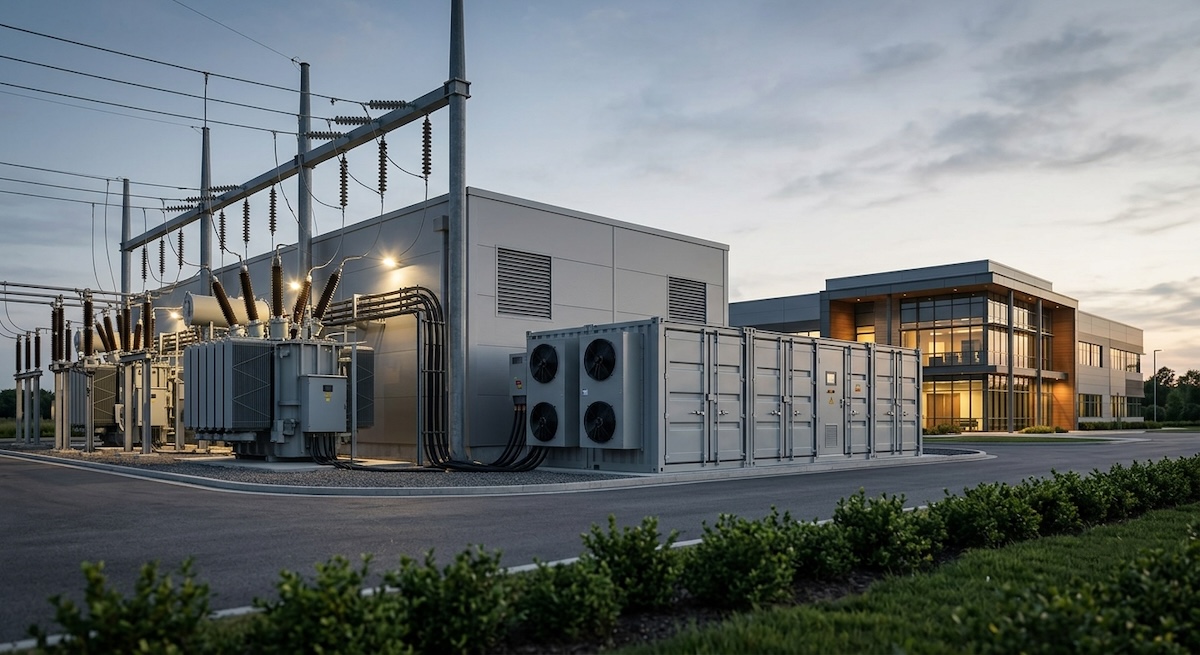
Instead of accepting the high-capacity band, you can install a battery to manage the load behind the meter.
The battery charges during periods of low demand and discharges precisely when your building attempts to spike. By “shaving” that peak, you artificially flatten your grid demand profile. You can then safely apply to the DNO to drop a band or two, utilising the battery to handle the excess capacity internally.
A Hypothetical look at the numbers:
Let’s look at a typical mid-sized commercial facility or shopping centre:
- The Baseline: The site has an ASC of 400kVA, placing it squarely in a costly tariff band. Forensic analysis shows the building actually hovers around 180kVA for most of the week but frequently spikes to a high peak of 380kVA for just two hours on Friday afternoons. Because of this weekly spike, the DNO will not allow a traditional capacity reduction.
- The Action: The business invests in a 200kW/400kWh behind-the-meter battery system.
- The Band Drop: With the battery configured to discharge and “shave” that Friday afternoon peak, the maximum demand seen by the grid never crosses 180kVA. The business can now successfully apply to the DNO to slash their ASC from 400kVA down to 200kVA, successfully dropping one capacity band.
The Financial Impact
| Cost Metric | Before Battery (400kVA) | After Battery (200kVA) | Net Annual Savings |
| Capacity & Network Charges | £28,000 / year | £14,000 / year | £14,000 |
| Peak DUoS Reductions (Red Zone Shaving) | £16,500 | £10,000 | £6,500 |
| Arbitrage (Optimisation) | – | – | £4,500 |
| Total Annual Benefit | £25,000 |
*for example, purposes only
The bottom line
Whether you can achieve a banding reduction through early, skilled negotiation with the network to drop your registered capacity, or by deploying intelligent battery storage assets to control your peak load behind the meter, the cost benefits are set to grow exponentially under the network’s new charging regime.
Secure your complimentary, no-obligation capacity health check before your next procurement cycle – email us at support@juttonenergy.com or call us on 01789 268132.