
Cost control, price certainty and business resilience are becoming the primary drivers of corporate renewable energy procurement, as businesses face growing pressure to demonstrate that their sustainability commitments deliver measurable commercial value, writes Tim McManan-Smith.
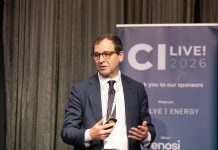
That was a central theme of a panel discussion at Cornwall Insight’s CI Live 2026 conference, where energy suppliers, advisers and a major corporate energy buyer explored the growing gap between sustainability reporting and the realities of energy markets.
Chaired by Robert Buckley, head of strategic accounts at Cornwall Insight, the session brought together James Hall, chief operating officer at Evolve Energy; Shaheer Hafeez, director of sustainability advisory at KPMG UK; Tom Andrews, senior consultant at Cornwall Insight; and Marko Vucenovic, commercial analysis manager, utilities and carbon, at John Lewis Partnership.
Hafeez explained that businesses are increasingly looking beyond the immediate cost of electricity or the ability to claim renewable energy consumption.
Instead, energy procurement decisions are becoming more closely connected to corporate strategy, financial resilience, risk management and the credibility of sustainability commitments.
While cost remains critical, businesses are also considering how procurement arrangements can provide greater predictability and reduce exposure to volatile energy markets.
Renewables become a commercial decision
Hall suggested that the motivation for adopting renewable energy solutions has shifted significantly.
Where decarbonisation was previously a principal consideration, businesses are increasingly prioritising budget certainty and protection against future energy price volatility.
Renewable energy agreements can provide opportunities to establish pricing arrangements linked more closely to generation project economics rather than relying entirely on wholesale electricity markets.
Hall also highlighted the growing importance of balancing costs, which have become a more significant concern for businesses since the energy crisis.
Matching electricity consumption more closely with renewable generation, including at individual settlement-period level, could help businesses manage some of these risks.
However, the commercial benefits must increasingly be demonstrated alongside environmental claims.
Hafeez noted that investors and regulators are placing greater scrutiny on corporate sustainability commitments, with businesses expected to provide evidence of the actions and outcomes supporting their reported progress.
Simply claiming to purchase renewable electricity is no longer necessarily sufficient to satisfy those expectations.
John Lewis explores longer-term agreements
Providing the perspective of a major energy consumer, Vucenovic explained that John Lewis Partnership purchases approximately 500GWh of electricity annually across its operations.
With retail margins under pressure, energy costs remain a significant consideration for the business.
The partnership has been examining a range of renewable procurement options, including virtual PPAs and longer-term agreements.
Vucenovic acknowledged that securing internal support for these arrangements can be challenging, particularly when businesses are accustomed to shorter procurement cycles.
However, he indicated that the organisation was making progress in gaining support for longer-term commitments.
The discussion highlighted a broader challenge facing corporate energy buyers: moving from conventional contracts lasting perhaps three years to renewable generation agreements potentially extending over 10, 20 or even 25 years.
Andrews said businesses were increasingly having to assess whether to invest directly in generation assets, work with third-party developers or enter long-term purchasing arrangements.
These decisions involve considerations extending well beyond energy pricing, including credit requirements, financial risk and the long-term strategic direction of the organisation.
New procurement models gain traction
The panel also discussed growing interest in alternative supply arrangements, including licence-exempt supply, private wire connections, on-site generation and battery storage.
Andrews highlighted activity at both ends of the market, from larger renewable generation projects to smaller installations incorporating storage and flexibility.
Hall suggested that new commercial structures were creating opportunities for generators and consumers to benefit from more closely aligned electricity production and demand.
These arrangements could also improve the financial viability of renewable generation projects by creating additional revenue opportunities.
However, access to suitable renewable generation may become increasingly competitive as more businesses seek arrangements offering closer matching between electricity consumption and production.
Andrews cautioned that delivering high levels of hourly renewable matching could become more difficult and expensive as adoption increases, particularly during periods of low wind and solar output.
Greater deployment of storage and other flexible resources would therefore become increasingly important.
Sustainability moves into the boardroom
Looking ahead, the panel agreed that energy procurement decisions would become more closely integrated with wider business strategy.
Hafeez argued that securing boardroom support for PPAs and other sustainability-related investments would depend increasingly on demonstrating their contribution to business value, resilience and risk management.
Andrews suggested that new commercial and financing structures could also make long-term renewable agreements accessible to a wider range of organisations, rather than predominantly those with the strongest credit ratings.
For John Lewis Partnership, Vucenovic said the immediate priorities remained managing costs, maintaining control over energy purchasing decisions and ensuring the business continued to progress towards its sustainability objectives.
Hall acknowledged that renewable procurement remained complex, with negotiations potentially requiring considerable time and legal expenditure.
The discussion underlined a changing corporate energy landscape in which sustainability ambitions remain important, but procurement decisions must increasingly stand up to commercial scrutiny.
For businesses, the challenge is no longer simply demonstrating that the electricity they purchase is renewable, but showing how their energy strategy delivers long-term financial and operational value.