 There comes a point in every technology’s journey when potential finally meets proof, when innovation, policy, and market readiness align to create real momentum. For floating offshore wind, that moment is now. With recent and rapid technological progress, maturing supply chains, and supportive policies from governments around the world, floating is now ready to play a central role in the global clean energy transition, explains Jon Salazar, CEO, Gazelle Wind Power.
One example of this supportive policy is the UK government’s current offshore wind auction, AR7. After the disappointments of AR5 where inflation, supply chain disruption, and unrealistic strike prices drove many developers away, the UK government has recalibrated its approach.
AR7 introduces new measures for floating offshore wind including 20-year contracts, improved flexibility for project eligibility, and supply-chain incentives such as the Clean Industry Bonus. These changes might sound procedural butshow that the UK is serious about making floating offshore wind commercially viable and globally competitive.
Indeed, this policy support is not happening in isolation. Around the world, we are seeing governments recognise that deep-water wind must become part of the renewable energy mix if we are to achieve net zero targets. In Europe for example, The European Commission recently approved €11billion of contracts for difference (CFD) funding from the French state for the backing of three FLOW projects, totalling 1.5GW of capacity. The Norwegian government is also considering the introduction of a €3 billion support scheme for floating in the North Sea.
In Portugal, Gazelle Wind Power’s home market, the government has recently confirmed its own auction round for floating offshore wind, with the aim of adding 2GW of capacity.
Developments in flow technology key to unlocking the sector
However, a supportive policy environment is just one piece of the puzzle. Technology development will also be a key determinant of whether the potential of floating translates into success.
Floating wind platforms face a fundamentally different set of engineering challenges compared to fixed-bottom systems. They must remain stable in rough seas, withstand dynamic forces over decades, and integrate seamlessly with the world’s largest turbines while maintaining cost efficiency and environmental responsibility.
Early demonstration projects across Europe and Asia have proven that floating wind works, but important lessons have been revealed. Poorly optimised platform designs can lead to excessive movement, wear, and fatigue, driving up maintenance costs and operational downtime. Installation complexity and limited port infrastructure can also add unexpected delays and expenses.
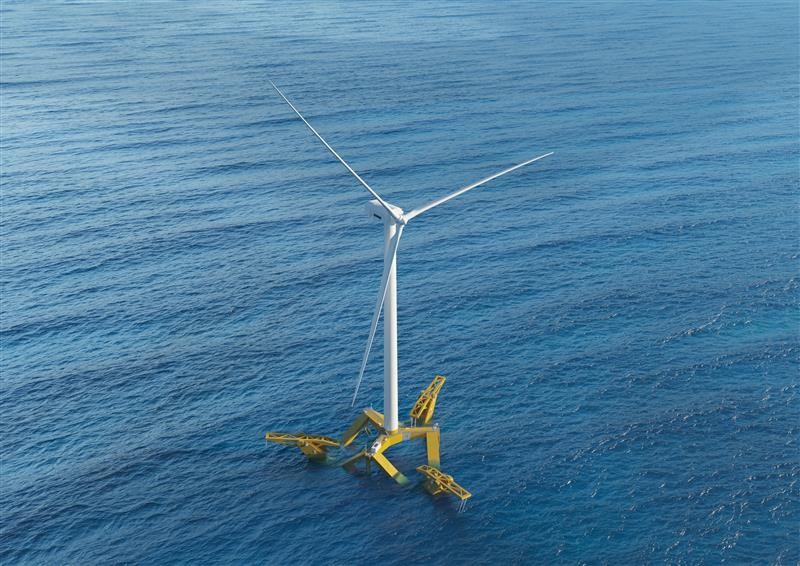
Engineers and designers across the floating wind sector are rethinking traditional approaches to make offshore generation more practical, scalable, and cost-effective. The most promising innovations are those purpose-built for wind rather than adapted from oil and gas. These designs prioritise stability, manufacturability, and reduced material use -enabling faster assembly, lower maintenance requirements, and better compatibility with existing port infrastructure.
As the industry prepares for a new generation of 20MW and larger turbines, platform developers are focusing on concepts that can support higher loads while remaining efficient and easy to industrialise. This shift is moving floating wind away from heavy, catenary-moored systems towards solutions that minimise seabed impact and enable large-scale deployment. By advancing lighter, modular structures that can be built in conventional shipyards and serviced from port, next-generation platforms are laying the groundwork for floating offshore wind at true industrial scale.
For developers, all of this means achieving the goal to reduce the Levelised Cost of Electricity by lowering capital and operating expenditures. For investors, it means greater confidence in project reliability. And for the world, it means faster deployment of renewable energy at scale.
Technology and policy dovetailing to drive the industry forward
With this kind of rapid technology development and a supportive policy environment dovetailing, the next decade will be a defining one for the sector. Success will largely depend on how policymakers, developers, technology providers and other stakeholders can work together in a more meaningful way.
For example, the introduction of the Clean Industry Bonus in AR7, encourages developers to work closely with domestic suppliers, helping to build local capabilities and create sustainable jobs. This kind of long-term industrial thinking is essential if floating wind is to contribute meaningfully to both energy security and economic growth. What’s more, the technologies and standards developed under AR7-supported projects will set benchmarks for future tenders across Europe, the Americas, and Asia-Pacific.
The future is floating
According to the International Renewable Energy Agency (IRENA), over 90% of the carbon dioxide cuts needed by 2050 could come from renewable energy and efficiency improvements. Over the past few years, advances in materials science, hydrodynamics, and digital monitoring have turned floating wind from a niche experiment into a serious industry, ready to take its rightful place in this global renewable energy mix.
The recent rapid development in floating offshore wind technology that is enabling bigger turbines to capture more wind energy, combined with a supportive policy environment from governments around the world means that floating offshore wind’s time has come.